
Pool Heat Exchanger
Pool water is usually heated through indirect heat transfer between the hot water of the boiler room and the pool water via a heat exchanger. In the following, we will review the types, technical specifications, selection method, and special purchase price of the pool heat exchanger. (since 2004)
Professional Guide to Selecting and Pricing Pool Heat Exchangers
A pool heat exchanger is a device that transfers heat from the hot boiler water to the pool water indirectly and without direct contact, increasing the pool water temperature.
This process ensures that the pool maintains a desirable and controllable temperature throughout the year.
Pool heat exchangers are generally manufactured in two types: shell and tube, and plate. The shell and tube model, due to its high durability, is suitable for large and public pools, while the plate model, due to its high thermal efficiency and compact size, is widely used in residential and semi-industrial systems.
To select a suitable pool heat exchanger, factors such as pool water volume, desired water temperature, boiler capacity, and pool water circulation rate must be considered.
A proper selection leads to faster heating, reduced energy consumption, and stable performance of the pool heating system.
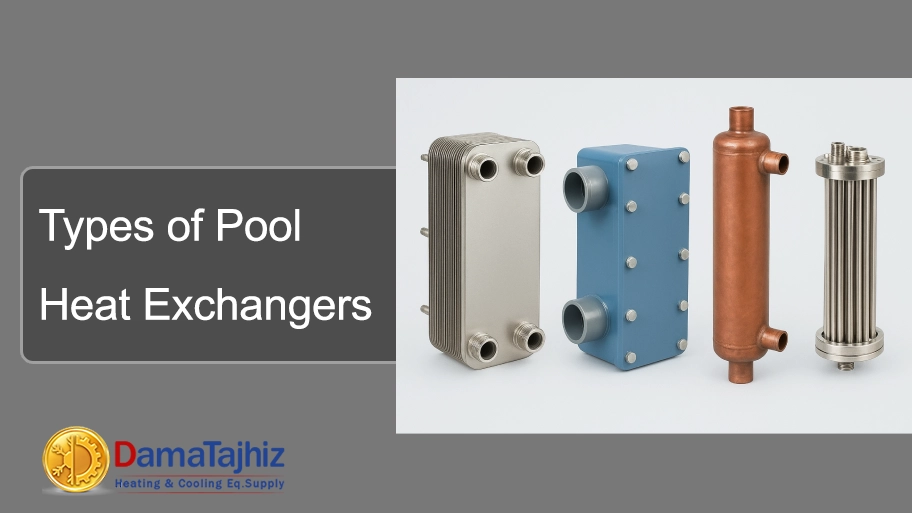
What is a Pool Heat Exchanger?
A pool heat exchanger is a device that transfers heat from a hot fluid to pool water without direct contact between the two fluids. These systems use temperature differences to transfer thermal energy from heat sources such as boiler hot water to the pool water.
The structure is designed with two separate flow paths, preventing direct contact using durable materials such as stainless steel, copper, or titanium. This design ensures efficient and safe heat transfer without mixing the fluids.
Using a pool heat exchanger allows precise temperature control, higher energy efficiency, and protection of water quality and equipment. So, heat exchangers are essential devices for either outdoor or indoor pools.
Most Common Type of Pool Heat Exchanger
The shell and tube heat exchanger is one of the most widely used systems for pool heating due to its high heat transfer capacity, resistance to scaling and pressure, and full compatibility with boiler systems.
In pool applications, hot boiler water flows inside the tubes (Tube Side), while cold pool water flows through the shell (Shell Side) for maximum efficiency.
The tubes handle heat transfer and act as a separator between fluids. In standard pools, tubes are typically made of copper or stainless steel (304/316), while titanium is required for saltwater pools.
Baffles inside the shell create turbulent flow, increasing heat transfer efficiency and stabilizing the tubes.
The shell is usually made of steel or stainless steel and includes inlet/outlet connections, temperature sensor ports, safety valves, and drain valves.
In summary, shell and tube heat exchangers are the best option for both residential and public pools due to durability, heating capacity, and compatibility with high flow rates.
Choosing the right type depends on pool size, usage, and environmental conditions.
Using a suitable heat exchanger stabilizes water temperature, reduces energy consumption, and extends equipment lifespan.
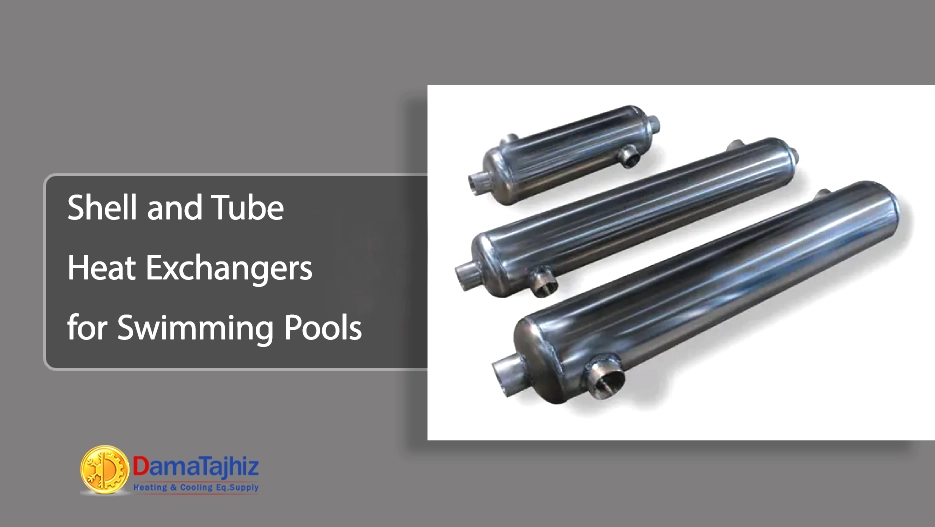
6 Important Tips for Selecting and Buying a Pool Heat Exchanger
If you plan to buy a pool heat exchanger, consider factors affecting heating speed, lifespan, and maintenance costs.
- Heating Capacity (BTU): Must match pool volume. Larger pools require higher capacity. Greater heat transfer surface equals faster heating.
As an empirical estimate, consider 1 square foot of heat transfer surface per cubic meter of pool water. (e.g., a 60 m³ pool requires a 60 ft² heat exchanger) - Material: Stainless steel or titanium offers high resistance to chlorine and chemicals but is more expensive. Copper tube exchangers are most common.
- Heat Source Compatibility: Ensure compatibility with boilers, packages, or solar systems. Typically shell & tube type.
- Energy Efficiency: Choose high-efficiency models to save energy.
- High Flow Rate: Prevent scaling and reduce maintenance needs.
- Flow Rate: Higher pump capacity increases heat transfer and reduces heating time.
Pool Heat Exchanger Price List 2026
Selecting a heat exchanger requires evaluating capacity, material, size, and pressure. Prices vary by brand, type, and materials.
| Brand | Approx. Price (USD) |
|---|---|
| Araz Sanat | 87 to 367 |
| Hyper Pool | 67 to 413 |
| Thermo Pool | 93 to 282 |
| Emaux | 128 to 205 |
| DamaTajhiz & Co. | 67 to 167 |
Based on the table, selection depends on pool type, volume, and required capacity.
Buyers can consult experts to choose the best option and benefit from pricing, warranty, and after-sales services. Installment purchase options are also available.
DamaTajhiz HVAC Co.; Thousands of Products for Thousands of Projects Across the Middle East (since 2004)
Applications of Pool Heat Exchanger
A pool heat exchanger is one of the key components of pool heating systems, responsible for transferring heat between two fluids without direct contact. In addition to providing the required water temperature, it plays a vital role in energy optimization, equipment protection, and enhancing the swimming experience.
1. Uniform Pool Water Heating
The primary function of a heat exchanger is to create and maintain the desired pool water temperature. The temperature difference between hot water sources such as boilers or solar systems and pool water enables heat transfer. The exchanger is designed to heat water evenly without temperature fluctuations. This feature is especially important in indoor pools and large facilities, where sudden temperature changes may affect swimmers’ health and equipment performance.
2. Protection and Extended Equipment Lifespan
Indirect heating through a heat exchanger reduces thermal stress and temperature shock on other equipment such as pool pumps, filters, jacuzzis, and water treatment systems. This not only improves efficiency but also significantly extends equipment lifespan.
3. Energy Saving and Optimization
Heat exchangers transfer heat efficiently by utilizing temperature differences between fluids. This reduces direct energy consumption and lowers operating costs. Modern systems optimize temperature and flow control to maximize efficiency and minimize energy usage.
4. Precise Temperature Control and Swimmer Comfort
One of the key advantages is accurate temperature control. Uniform water temperature improves comfort and prevents hot or cold spots. This is especially important in recreational and therapeutic pools, where improper temperature may negatively affect users.
5. Flexibility and Compatibility with Energy Sources
Pool heat exchangers can operate with various heat sources:
- Boiler systems: reliable heat source for large pools
- Solar systems: renewable energy usage
- Electric and gas systems: fast and precise control
6. Special Applications in Different Pools
- Indoor pools: stable temperature and high efficiency
- Outdoor pools: energy saving in cold conditions
- Jacuzzis and private pools: enhanced comfort and luxury
A pool heat exchanger not only heats water but also ensures precise control, energy efficiency, and equipment protection, making it one of the most essential components of a pool system.
How a Pool Heat Exchanger Works
A pool heat exchanger transfers heat from a hot fluid to pool water without direct contact. It operates based on temperature difference, where the hot fluid transfers its energy through the exchanger wall to the cooler pool water.

DamaTajhiz HVAC Inc.; Guide to Choosing and Buying HVAC Systems in the Middle East (Since 2004)
Working Process
The process involves several key stages:
1. Hot Fluid Inlet
Hot water from boilers or heating systems enters the exchanger through a dedicated path designed for optimal flow and pressure.
2. Pool Water Inlet
Pool water flows through a separate channel without mixing with the hot fluid, ensuring safe heat transfer and uniform temperature distribution.
3. Heat Transfer
The exchanger wall, made of stainless steel, copper, or titanium, transfers heat efficiently without affecting water quality.
4. Fluid Outlet
After heat exchange, the warmed pool water exits ready for use, while the hot fluid returns for reheating.
Performance Considerations
Proper operation requires attention to key technical factors:
1. Counterflow vs Parallel Flow
Counterflow design improves efficiency by maintaining higher temperature differences.
2. Large Heat Transfer Surface
Greater surface area increases efficiency and reduces heating time.
3. Precise Control
Valves, thermostats, and sensors ensure stable operation.
4. Corrosion Resistance
Materials like stainless steel and titanium prevent damage from chemicals.
5. Maintenance
Regular cleaning and inspection ensure optimal performance.
This process ensures efficient heating, energy saving, and equipment protection.
DamaTajhiz & Co.; Providing HVAC Systems and Equipment Across the Middle East (Since 2004)
Accurate Capacity Calculation
Selecting the right exchanger requires precise calculation. Undersized units fail to heat properly, while oversized ones increase costs.
Key Factors
- Pool volume
- Temperature difference
- Heating time
- Heat transfer coefficient
Heat Exchanger Capacity Estimation Formula
Method 1: As a rule of thumb, for indoor pools consider 1600 kcal/h per m³ and for outdoor pools 1800–2000 kcal/h per m³.
Example: pool size 1.5×8×6 = 72 m³
Indoor: 1600 × 72 = 115,200 kcal
Outdoor: 2000 × 72 = 144,000 kcal
Convert to kW: divide by 860
115200 / 860 = 134 kW
144000 / 860 = 167 kW
Then divide by 2 to get exchanger size in ft²:
134 / 2 = 67 ft²
167 / 2 = 84 ft²
Select the nearest standard capacity available.
Method 2: Simple formula for estimating pool heat exchanger capacity (in feet)
A = V × 0.9
Where:
A = Heat exchanger surface area (square feet)
V = Pool volume (cubic meters)
Example:
For a 60 cubic meter pool:
60 × 0.9 = 54
(The 0.9 coefficient is a practical conversion factor used in the pool industry to convert pool volume in cubic meters into heat exchanger capacity in shell-and-tube heat exchangers.)
Therefore, for a 60 cubic meter pool, a minimum heat exchanger capacity of 54 feet is required.
Practical Notes in Capacity Selection
- It is always better to consider a safety margin to ensure sufficient heating under special conditions.
- The heat exchanger must be coordinated with the pool pump and filtration system to ensure optimal water flow and heat transfer.
- For indoor pools, outdoor pools, jacuzzis, or public pools, the capacity should be selected based on volume and usage type.
Practical Notes in Selecting Pool Heat Exchanger Capacity
Choosing the right heat exchanger capacity for a pool is a key step in designing and operating an efficient heating system. Observing practical considerations ensures that the exchanger can reach the desired water temperature, reduce energy consumption, and increase the lifespan of auxiliary equipment.
1. Safety Margin Consideration
It is always recommended to include a safety margin when calculating heat exchanger capacity. This is due to environmental changes, initial water temperature, evaporation rate, and sudden pool usage. This margin ensures that even in special conditions or cold environments, sufficient and uniform heating is maintained for swimmer comfort.
2. Coordination with Other Equipment
The heat exchanger must be coordinated with pool filters, pumps, and the water treatment system. Water flow from the pump to the exchanger and back to the pool must be adjusted to maximize heat transfer without additional pressure. Lack of coordination may reduce efficiency, cause temperature fluctuations, and damage equipment.
3. Matching Pool Type
Heat exchanger capacity should be selected based on pool type and water volume:
- Indoor pools: Medium to high capacity is recommended due to reduced heat loss.
- Outdoor pools: Higher capacity is required due to evaporation and environmental temperature effects.
- Jacuzzis and villa pools: Medium capacity is usually sufficient, but precise temperature control is important.
- Public and club pools: High capacity with safety margin is required for continuous and uniform heating.
4. Heating Time Requirement
The heat exchanger must be able to heat the pool water within the required time. For example, if the goal is to reach the desired temperature within a few hours, capacity must be calculated based on water volume and temperature difference.
5. Materials and Design
Material and design also affect capacity selection. Exchangers with larger surface contact and corrosion-resistant materials such as stainless steel or titanium provide higher heat transfer efficiency and can deliver greater effective capacity without increasing size or cost.
By following these practical guidelines, pool heat exchanger capacity can be optimized. This ensures uniform water temperature, reduced energy consumption, and longer equipment life.
DamaTajhiz HVAC Co.; The Best Prices and Reputable Brands of HVAC Systems in the Middle East (Since 2004)
Types of Shell and Tube Heat Exchangers
Shell and tube heat exchangers are widely used in pool heating systems, jacuzzis, and industrial installations. They transfer heat between two fluids through tube walls without direct contact, ensuring high thermal efficiency and stable temperature control. In pools, they reduce energy consumption and increase equipment lifespan through optimized heat transfer design.
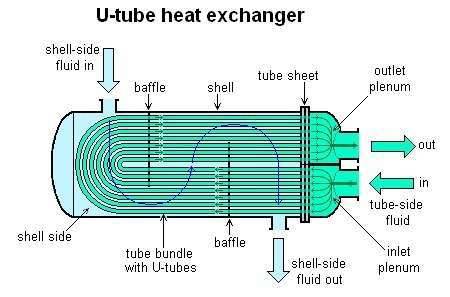
U-Tube Heat Exchanger
In a U-tube heat exchanger, tubes are bent into a U shape and attached to a single tube sheet. One fluid flows inside the tubes while the other flows in the shell. Heat transfer occurs through the tube walls, and the fluid returns through a 180-degree bend, creating a two-pass system.
This design provides high efficiency and uniform temperature distribution. Using a single tube sheet simplifies manufacturing and reduces cost. U-tube exchangers are suitable for pools with limited space and require fast and uniform heating, while ensuring compatibility with pump and filtration systems.
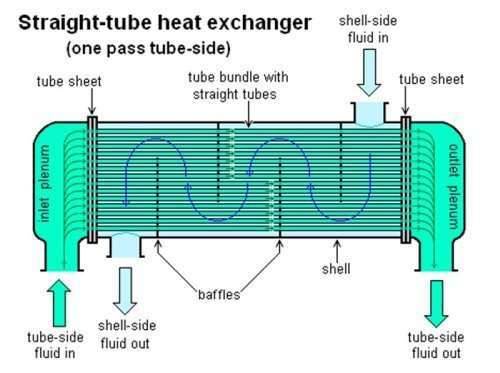
Straight One-Pass Heat Exchanger
In a straight one-pass exchanger, tubes are straight and fluid enters from one side and exits from the other. Two tube sheets are used to maintain a straight flow path, making mechanical cleaning and maintenance easier.
This type is ideal for small pools, jacuzzis, and villa pools where scaling and maintenance are important. Straight tubes reduce pressure drop and ensure smooth flow control, while maintaining efficient heat transfer and uniform temperature distribution. These exchangers integrate well with pool pumps and filtration systems, ensuring stable and fast water heating.
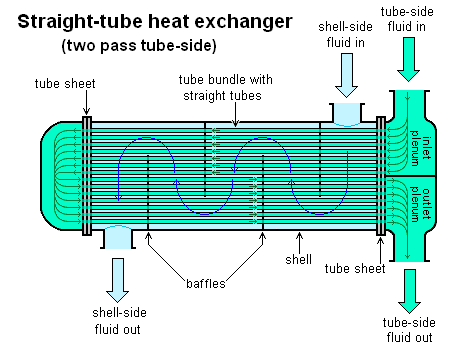
Straight Two-Pass Heat Exchanger
The two-pass heat exchanger is a combination of a straight design and a two-stage fluid flow path. In this model, the fluid enters from one side of the tubes and after passing through a straight path, it rotates 180 degrees and enters another set of tubes, then exits from the same outlet side. This design allows the fluid to pass through two heat transfer stages, maximizing the temperature difference.
Due to the straight tubes, mechanical cleaning and easy maintenance are still possible. The use of two tube sheets in this model allows precise temperature and flow control, ensuring uniform heat distribution throughout the exchanger. The two-pass heat exchanger is the most suitable option for public pools, industrial pools, and large jacuzzis that require both high thermal efficiency and easy maintenance.
Installation of Heat Exchanger in Pool Heating System
Proper installation of a heat exchanger in a pool heating system is a key factor for optimal performance and equipment lifespan. Plate heat exchangers, due to their stainless steel body and high thermal efficiency, are an ideal choice for pool water heating.
For correct operation, the heat exchanger must be installed after the filtration system and before the water disinfection equipment such as a chlorinator. This arrangement ensures that clean and particle-free water enters the exchanger, preventing scaling and corrosion while optimizing heat transfer.
In pool heating design, the heat exchanger is usually placed in the water circulation line before the main pumps and auxiliary equipment to ensure uniform water temperature. This setup also enables precise temperature control and full coordination with other pool equipment such as pumps, filters, and chlorinators, increasing overall system efficiency.
By following these principles, the heat exchanger can heat pool water quickly with minimal energy loss while extending the lifespan of the heating system.
Difference Between Simple and Flanged Pool Heat Exchangers
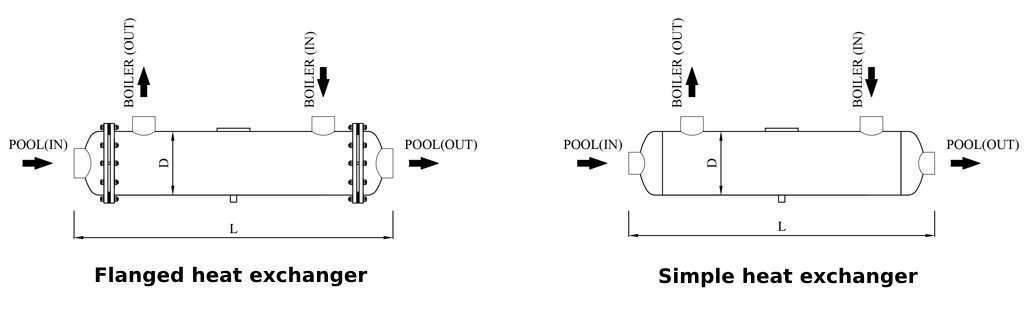
Pool heat exchangers are generally divided into two main types based on design and fluid connection: simple heat exchangers and flanged heat exchangers. This design difference directly affects performance, maintenance, and lifespan of the heating system.
In a simple heat exchanger, tubes and shell are fixed without detachable connections, and fluid paths are usually welded or threaded. This makes installation fast and cost-effective, suitable for small pools or medium-volume systems. However, maintenance and mechanical cleaning are limited, and repair often requires removing the entire unit.
In contrast, flanged heat exchangers use flange connections that allow easy disassembly. This enables cleaning, inspection, and maintenance without removing the entire unit. Flanged models are suitable for large pools, public jacuzzis, and industrial systems where frequent maintenance is required. They also withstand higher working pressures and integrate easily with pumps and other equipment.
In summary, the main difference lies in connection type, disassembly capability, maintenance ease, and pressure resistance. The selection should be based on pool type, water volume, operating pressure, and maintenance requirements.
Buying a Pool Heat Exchanger
When selecting and purchasing a pool heat exchanger, in addition to capacity and heat transfer area calculations, factors such as type, dimensions, material, operating pressure, and inlet/outlet pipe diameter are also important.
You can choose your required shell-and-tube pool heat exchanger from reputable Iranian and international companies introduced by DamaTajhiz HVAC corporation, such as Aquamarine and Thermopol, after consulting with technical experts.
In the DamaTajhiz technical HVAC collection, detailed specifications of dozens of pool heat exchanger models from reputable brands with official warranties are provided to ensure an optimal and intelligent purchase experience. When buying, consider whether the pool is indoor or outdoor, public or private, required heating time, temperature difference, and number of required exchangers.
Price of Pool Heat Exchanger
The price of a pool heat exchanger is influenced by several technical and structural factors:
- Thermal capacity (heat transfer area): Higher capacity models transfer more heat and are more expensive due to larger size and more materials.
- Body and tube material: Stainless steel, titanium, and copper materials affect corrosion resistance and durability. Titanium models are more expensive due to superior resistance and longer lifespan.
- Size and weight: Larger exchangers used in public or indoor pools require more materials and are more expensive.
- Design type: U-type, single-pass, two-pass, simple, or flanged designs have different costs depending on complexity and maintenance features.
- Operating pressure and pipe diameter: High-pressure models require stronger materials and engineering, increasing cost.
- Brand and warranty: Reputable brands with official warranties such as DamaTajhiz & Co. usually have higher prices but offer better reliability and lifespan.
Overall, the price should be selected based on pool volume, type (indoor/outdoor), usage intensity, system pressure, and budget. DamaTajhiz HVAC company provides technical comparisons and updated pricing to help users make an informed and economical purchase.
You can order any HVAC and MEP products, including different types of pool equipment, air washers, cooling towers, air handling units, chillers, industrial evaporative coolers, air curtains, burners, cast-iron or steel boilers, heat exchangers, gas heaters, unit heaters, circulation pumps, sand filters, water and fuel storage tanks, and more, from countries such as the UAE, Armenia, Tajikistan, Georgia, Azerbaijan, Turkey, Oman, Pakistan, Turkmenistan, Afghanistan, Kuwait, Bahrain, Qatar, Iraq, and others across Asia, the Middle East, and Europe, and have them delivered to your city (Manama, Baghdad, Karachi, Dubai, Sharjah, Muscat, Riyadh, Abu Dhabi, Kuwait City, Jeddah, Sana'a, and Doha Amman, Sulaimaniyah, Sofia, Kirkuk, Islamabad, Mosul, Erbil, Dushanbe, Aleppo, Damascus, Baku, Beirut, and Kabul) in the shortest possible time. So, contact us by phone call or WhatsApp message through the number +98-930-288-0251.
"Knowledge Fuels Better Choices"
Registered Trademark and Stewardship Business Licenses Issued by the Union of Virtual Business Association and the HVAC Equipment Industry.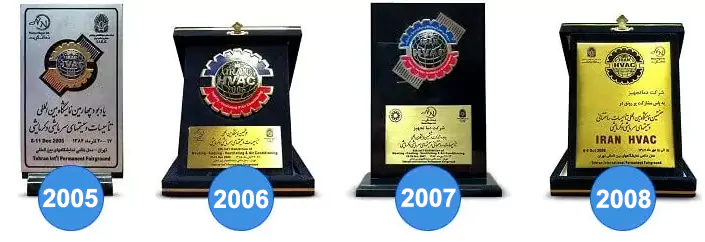
DamaTajhiz HVAC Inc. Participation at International HVAC and Construction Facilities Exhibitions Demonstrates its Global Reach and Commitment to the Industry.
We Look Forward to Your Call and the Opportunity to Meet You
SHARE THIS CONTENT TO SPREAD THE KNOWLEDGE
 |
 |
 |
 |
 |


Head Office: No. 463,Talebian Alley,Taleghani St.Tehran,Iran

DamaTajhiz has provided the opportunity to sell and ship specialized HVAC equipment for applicants in the following countries as the first and the most popular online store for selling HVAC equipment (Heating , Ventilation , Cooling , Air conditioning) in the Middle East : Afghanistan – Tajikistan - Uzbekistan – Turkmenistan – Azerbaijan – Armenia – Georgia – Turkey – Iraq – Syria – Jordan – Kuwait – Emirates – Qatar – Oman.


