
Pool Heater
Selecting and purchasing a pool heater requires careful consideration of technical specifications, heating capacity, and pricing. In the following, we present different pool water heating systems along with a special price list for pool heaters. (Since 2004)
Expert Guide to Selecting and Pricing Pool & Jacuzzi Heaters
Since the temperature of incoming pool water before heating is typically around 12°C, which is not comfortable for most users—especially women and children—modern and well-equipped pools usually utilize various methods to heat the water and enhance user comfort. A pool heater is a device designed to raise the temperature of pool and jacuzzi water to a set range, ensuring suitable thermal conditions. Proper temperature control not only reduces evaporation and, in indoor pools, humidity levels, but also helps maintain stable environmental conditions. Additionally, the stable operation of a pool heater can help prevent thermal stress and extend the lifespan of associated equipment.
Maintaining the correct pool water temperature—typically between 27°C and 29°C—and jacuzzi water temperature between 40°C and 43°C is also important for reducing fuel consumption. In many projects, heating systems not only heat pool and jacuzzi water but also supply domestic hot water for the facility. This integration improves energy efficiency and reduces maintenance costs. Ultimately, proper selection and correct installation of the heating system play a key role in ensuring user comfort.
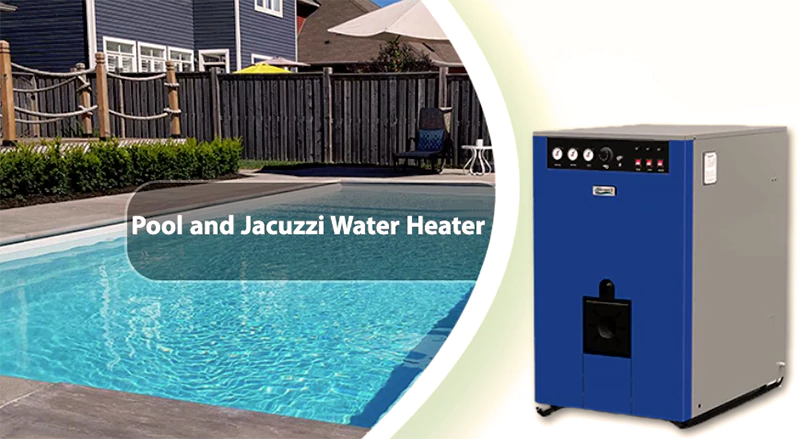
What is a Pool Heater?
A pool heater is one of the most important equipment for optimal and comfortable use of residential and public pools. As we know, pool water is in direct contact with the surrounding air, especially during cold seasons or cold nights, causing water temperature to drop. Swimming in cold water is not only unpleasant but can also cause issues such as muscle cramps or hypothermia. Here, the importance of using pool heating systems, particularly a pool heater, becomes clear.
Simply put, a pool heater is a device responsible for raising the pool or jacuzzi water to the ideal temperature and maintaining it within the same range. According to standards, the suitable temperature for pool water is usually between 27 and 29 °C, and for jacuzzi water between 40 and 43 °C. To achieve this temperature, different methods and equipment are available, selected according to project conditions.
One common equipment is a pool heating package. A pool package works similarly to home heating packages but has higher thermal capacity to heat a large volume of water. In many private villas and pools, a pool heating package is used to also provide jacuzzi water and hot water for other uses. This solution is economical and integrates heating management.
Importance of Maintaining Pool Water Temperature with a Pool Heater
Maintaining pool water temperature is one of the most important factors for optimal use, user comfort, and increasing equipment lifespan. A pool heating system does not only heat the water, but it must also maintain the temperature within a defined and stable range. Continuous temperature fluctuations increase energy consumption and can negatively affect water quality and swimmer health and comfort.
1. Thermal and Energy Aspects
- Heating systems that operate continuously without a thermostat or precise temperature control increase fuel or electricity consumption.
- Maintaining temperature using electronic thermostats ensures optimal combustion and pump performance, increasing overall system efficiency.
- Preventing large temperature drops or excessive rises protects the heat exchanger and pipes from thermal shocks and increases equipment lifespan.
2. User Comfort and Safety
- The ideal temperature for pools is usually between 28 and 30 °C.
- If the temperature drops suddenly, using the pool becomes uncomfortable or even dangerous, especially for children and the elderly.
- Temperature fluctuations may cause muscle cramps, heat stress, or sometimes low blood pressure.
3. Water Quality and Hygiene
- Large temperature changes affect the chemical balance of pool water. Chlorine and other disinfectants do not function effectively at unstable temperatures.
- Maintaining temperature helps keep pH levels and chemical concentrations within the specified range and prevents microorganism growth in the water.
4. Equipment Durability and Maintenance
- Temperature fluctuations cause repeated expansion and contraction of the heat exchanger and pipes, increasing the risk of cracks or leaks.
- Controlling and maintaining water temperature prevents calcium carbonate deposition in the heat exchanger and reduces the need for frequent maintenance or acid cleaning.
Maintaining pool water temperature with a heater is a technical and operational necessity. It enhances swimmer comfort and safety, increases energy efficiency, preserves water quality, and extends equipment life. Therefore, attention to temperature control systems and precise sensors in designing and operating a pool heating system is critical.
DamaTajhiz HVAC Co.; Thousands of Products for Thousands of Projects Across the Middle East (since 2004)
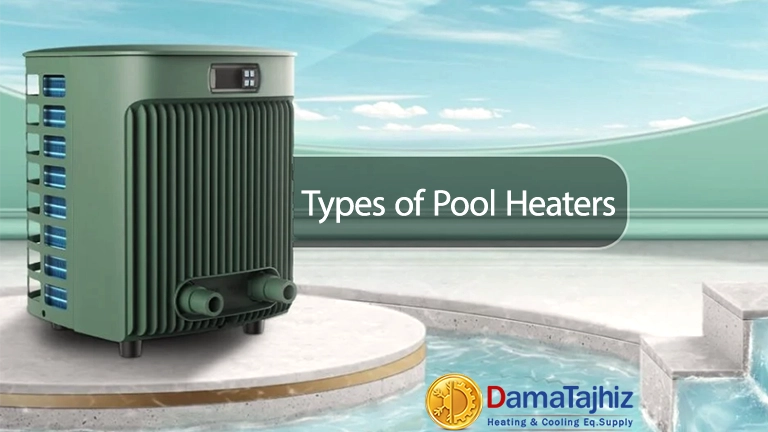
Types of Pool Heating Packages
Pool heating packages are a common method for providing ideal water temperature for pools and jacuzzis. These systems offer high efficiency, suitable dimensions, and the ability to provide hot water for the building at the same time, serving as a good alternative to old boiler heaters. However, pool-specific packages have different types, and selection depends on project conditions, fuel type, and pool size.
1. Gas Pool Heating Package
The gas package is the most common type of pool heating package. It uses natural gas or LPG as fuel, and due to its availability and low energy cost in Iran, it is very popular. These packages are usually available in two types: wall-mounted and floor-standing, and can be used for residential pools as well as larger projects.
2. Diesel Pool Heating Package
In areas without natural gas availability, diesel-operated packages are a suitable option. They operate with a diesel flame and have high thermal capacity. However, diesel fuel is more expensive, and maintenance requires more care.
3. Electric Pool Heating Package
Electric packages are more suitable for small pools or residential jacuzzis. They use electric elements to heat the water and are very easy to install. The main advantage is no pollution and no need for a chimney, but they consume high electricity, so they are recommended only for small capacities.
Pool Heater Price List
Electric pool heater prices vary depending on thermal capacity, material, energy efficiency, pool size, weight, dimensions, and more. You can choose the best model for your pool from dozens of models at the best prices in DamaTajhiz HVAC corporation.
| Pool Heater Brand | Approx. Price (USD) |
| Emerald Pool Heater | Upon inquiry |
| Hyper Pool Heater | 170 – 300 |
| Araz Sanat Pool Heater | 290 – 975 |
| Khazar Manba Pool Heater | 1005 – 2945 |
Note that electric pool heater prices provided by DamaTajhiz & Co. are updated and include consumer discounts, as well as the best price guarantee. Energy saving for pool heaters: According to research, about 60–70% of heat loss in pools occurs from the water surface, so using measures to reduce this heat loss significantly decreases heating and fuel costs. One of the most effective ways is using a pool cover when not in use, which preserves energy and water temperature (like a blanket) and prevents surface contamination (for outdoor pools).
Factors Affecting Pool Heater Price
If you intend to choose a suitable heating system for your pool, the first thing you will likely consider is the pool heater price. Pool heaters come in different types, each with a different price based on technology, capacity, and brand. Understanding the main factors affecting cost helps you make a more informed and economical decision.
1. Type of Pool Heater
The most important factor is the type of heating system. Pool heaters are generally divided into three main groups:
Electric Heater
Gas Heater
Hybrid Heaters or Heat Pumps
Among them, electric heaters usually have a lower purchase price than gas systems, but the energy cost may be higher in the long term. Heat pumps have a higher initial price but offer excellent efficiency.
2. Capacity and Power
Capacity is determined by pool size. The larger the water volume, the stronger the heater needed, which directly affects price. Higher power means higher energy consumption and higher initial cost.
3. Material and Build Quality
High-quality heaters are usually made of corrosion and moisture-resistant materials. This increases device lifespan and also affects the price. Professional and rust-resistant models are more expensive but have lower maintenance costs.
4. Brand and Country of Manufacture
Another important factor is the brand. Global brands often provide better quality and after-sales service but are more expensive. Local brands offer more economical options.
5. Additional Features and Technologies
Systems with smart thermostats, remote control, digital display, or better energy efficiency have higher prices. Adding any smart feature increases the final price of the heater.
Ultimately, to choose the best option, consider pool size, energy type, budget, and usage duration. Reviewing these factors helps you select the most suitable product and understand the reason for price differences in the market. If you are looking for an economical option, comparing different models and electric heater prices can be an ideal starting point.
How a Pool Heater Works
The pool heating capsule (Pool Heating Cage) or the heat exchanger system and water distribution in the pool is one of the core components for controlling temperature and optimizing energy consumption in residential and industrial pools. This system is designed to transfer heat from a thermal source (such as a boiler, heat pump, or solar collector) to pool water while maintaining stability, efficiency, and safe operation.
DamaTajhiz & Co.; Guide to Choosing and Buying HVAC Systems in the Middle East (Since 2004)
Main Components and Operation
The pool heating system consists of several components working together to heat pool water and maintain the optimal temperature. Each component plays a crucial role in increasing efficiency, reducing energy consumption, and ensuring safe operation. Below is a review of the main components and how they work.
Heat Exchanger
The heat exchanger is the heart of the pool heating system and is responsible for transferring heat from the energy source to the pool water. In this unit, hot water produced by a cast-iron or steel boiler or heat pump flows through the exchanger coils. Simultaneously, pool water passes around these coils and absorbs heat indirectly without direct contact. The exchanger is usually made of stainless steel, titanium, or copper-nickel alloys to withstand corrosion, chlorine, salt, and chemicals in the water.
Circulation Pump
The circulation pump plays an important role in continuously circulating pool water. It pumps water from the pool, passes it through the heat exchanger, and returns it to the main pool. Continuous circulation ensures even heat distribution and prevents hot or cold spots. Using a pump suitable for pool size directly affects system efficiency.
Control System & Thermostat
This component constantly measures and controls pool water temperature. When the temperature reaches the desired limit (usually between 28–30 °C), the system instructs the heat source to reduce or temporarily stop heat flow to the exchanger. When the temperature drops, the system resumes heating to ensure the temperature remains within the ideal range.
Protective Cage
The protective cage is a structure installed around the heat exchanger and heating equipment to ensure user safety and device integrity. This enclosure prevents direct contact with hot components and protects the system from moisture, dust, or environmental contaminants. Besides the safety aspect, a well-designed cage also improves ventilation and extends the lifespan of the equipment.
Safety Circuit
To prevent potential hazards from excessive pressure or temperature, a safety circuit is included in the pool heating system. This circuit contains a pressure relief valve, emergency shut-off switch, and precise thermal sensors that automatically stop system operation in case of any malfunction or abnormal condition. This circuit guarantees full safety for both users and equipment.
Overall Operation of the Pool Heating System
In a complete cycle, a heat source such as a boiler or heat pump generates the required thermal energy. This energy enters the heat exchanger via the primary circuit. Meanwhile, the circulation pump passes cold pool water through the secondary circuit, allowing it to absorb heat from the exchanger coils and increase in temperature. The heated water then returns to the pool, and this cycle continues until the desired temperature is reached. The control system intelligently adjusts the heat flow to prevent temperature fluctuations, providing a stable and uniform environment for swimmers.
Technical Notes:
- Thermal efficiency depends on the temperature difference between the heat source and the pool water.
- Proper insulation of piping significantly reduces energy loss.
- For saltwater or high-chlorine pools, using titanium heat exchangers is recommended due to their higher corrosion resistance.
- The heating cage capacity must be calculated based on pool volume (m³), ambient temperature, and heat loss.
DamaTajhiz & Co.; Providing HVAC Systems and Equipment Across the Middle East (since 2004)
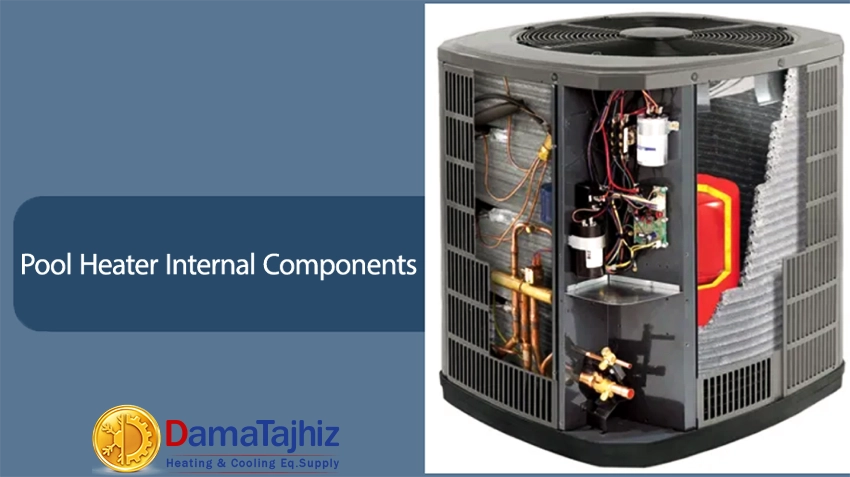
Internal Components of the Pool Heater
The pool water heating package is an integrated system responsible for maintaining the pool water at ideal conditions. This system combines mechanical, thermal, and control equipment to simultaneously handle heating, circulation, and water treatment. Proper component selection and precise circuit design increase energy efficiency and ensure the longevity of the equipment.
- Boiler or Gas/Diesel Burner – The main source of thermal energy.
- Heat Exchanger – Transfers heat from the boiler circuit to the pool water.
- Pool Circulation Pump – Ensures continuous water circulation between the pool and heat exchanger.
- Heating Circuit Pump – Circulates hot boiler water toward the heat exchanger.
- Closed or Open Expansion Tank – Compensates for water volume changes due to temperature rise.
- Control Valves (Check Valve, Safety Valve, Gate Valve) – Controls and secures water flow.
- Thermostat and Temperature Control System – Maintains the desired pool water temperature.
- Pool Filter (Sand Filter) – Removes suspended particles and prevents heat exchanger clogging.
- Safety Switches and Pressure/Temperature Sensors – Protects the system against excessive pressure or temperature.
- Electrical Panel and Central Control System – Manages pumps, burners, and the control system.
- Primary and Secondary Piping – Routes thermal energy and circulates pool water.
- Piping Insulation – Reduces energy loss and improves overall efficiency.
Together, these components ensure continuous filtration, heating, and maintenance of stable pool water temperature. Correct design and use of durable materials (especially in the heat exchanger) are crucial because pools are corrosive environments with high chlorine and humidity. Following technical guidelines allows the pool heating package to operate for years without efficiency loss and ensures user comfort.
Installation of the Pool Heating Package
Installing a pool heating package is a sensitive and fully technical process that must comply with safety standards and hydraulic principles. Proper installation prevents energy loss, ensures high efficiency, and increases equipment lifespan. The main installation steps include the following:
1. Preparing the Installation Site
Before installing the equipment, the site must be fully prepared. The chosen location should be dry, well-ventilated, and provide easy access for maintenance. The floor must be level, strong, and capable of supporting equipment weight such as boilers, heat exchangers, and pumps. These measures prevent vibrations, water leaks, or equipment damage.
2. Installing Main Equipment
After preparing the space, main equipment such as the boiler and heat exchanger are mounted on strong bases in positions that allow easy periodic maintenance. The heating circuit pump and circulation pump must be installed according to the execution plan and in the correct flow path to ensure proper water circulation in primary and secondary circuits.
3. Executing Piping of Circuits
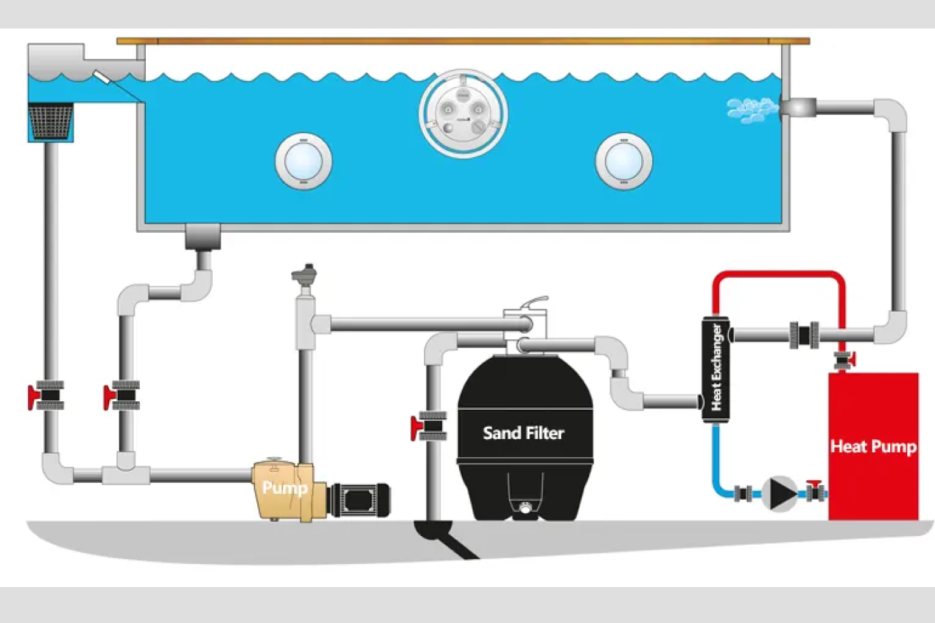
At this stage, primary and secondary circuit piping is installed. In the primary circuit, hot water exits the boiler, passes through the heating pump, and enters the heat exchanger. In the secondary circuit, pool water passes through the sand filter and circulation pump, enters the heat exchanger, and then returns to the pool.
During piping installation, check valves, safety valves, and shut-off valves must be correctly installed at proper locations to ensure system control and safety.
4. Installing Auxiliary Equipment
Next, auxiliary equipment such as expansion tanks, electrical panels, and temperature and pressure sensors are installed and connected. Proper connection of these components is crucial because they control and protect the entire system. Wiring must follow safety standards and technical diagrams to prevent any electrical faults or hazards.
5. Start-up and Final Adjustments
After installation, system circuits must be fully purged of air to prevent air bubbles in the water flow. The working pressure should be adjusted between 1–1.5 bar. Then, the thermostat is set to the desired temperature of 28–30 °C.
Finally, the operation of all components, including pumps, burner, heat exchanger, and safety systems, is tested to ensure proper and flawless functionality.
By carefully following these steps, the pool heating system is ready for safe, stable, and highly efficient operation.
Determining Pool Heating Capacity
It should be noted that, in practice, a full formula for calculating the required thermal energy for heating the pool water is often not used. Instead, the required heating capacity is estimated based on experience, ambient temperature, and pool water volume.
QT = Q1 + Q2
Q1 = mCp∆t / t
- QT = Total heating required for the pool in btu/hr
- Q1 = Thermal energy needed to heat pool water in btu/hr (English units)
- m = Mass of pool water (m = ρv), where ρ = 8.3 lb/gal and v = pool volume in US gallons
- Cp = Specific heat capacity of water (English system) = 1 btu/lb.°F
- ∆T = Difference between initial and desired water temperature in °F (for indoor pools, ∆T is usually less than for outdoor pools, and is calculated according to owner requirements, typically 40–45 °F)
- t = Desired time (hours) to reach the target pool water temperature
Q2 = UA∆T
- Q2 = Thermal energy lost from pool walls in btu/hr
- U = Overall heat transfer coefficient of pool walls = 10.5 btu/h·ft²·°F
- A = Surface area of the pool (floor and walls) in ft²
- ∆T = Temperature difference between pool water and ambient air in °F
DamaTajhiz HVAC Co.; Guide for Selection and Purchase of Pool, Sauna, and Jacuzzi Equipment (Since 2004)
Factors Affecting Calculation of Required Pool Heating Capacity
When calculating and deciding on the type and capacity of a pool water heating system, including pool packages, pool and jacuzzi heaters, boilers and burners, or heat exchangers, it is essential to carefully consider the following factors. Attention to these points ensures correct equipment selection, accurate cost estimation, and helps compare electric pool heater prices with other heating methods.
- Total water volume in the pool, a primary parameter in determining heating capacity.
- Pool surface area in contact with air, which determines heat loss.
- Time required to reach the desired initial water temperature, usually considered 24 hours.
- Final water temperature based on usage type (public or private) and operational conditions, typically between 80–86 °F (27–30 °C).
- Average ambient temperature in the coldest month, which is critical for outdoor pool heat load calculations.
- Average air temperature of the pool hall, considered in indoor pool calculations, affecting system choice and even electric heater pricing.
✅ Thank you for your valuable time and attention in reviewing the above information. Should you require further details or prompt answers to your questions, please contact the sales experts of DamaTajhiz Specialized Corporation during business hours before selecting the required pool water heating system between different types.
Tel: +98-021-88822550
+98-021-86071814
+98-930-288-0251
Methods of Heating Pool and Jacuzzi Water
The types of pool and jacuzzi water heating methods are as follows:
- Boiler, burner, and heat exchanger
- Heating package (boiler package)
- Electric heater (electric heat pump)
- Solar panel
Heating the Pool Using Boiler, Burner, and Heat Exchanger
Heating a pool using a boiler (cast iron or steel) and a heat exchanger (shell & tube or plate type) is one of the most common and well-known methods for heating large and small open and indoor pools as well as public jacuzzis.
If the pool water needs to be heated within a specific time, a boiler, burner, and heat exchanger with higher capacity should be used.
Maximum pool water heating time (meaning the time it takes for pool water to rise from cold to the desired temperature).
Note: For recreational pools (used once a week, like garden or villa pools), the required heating time by the pool water heater is 24 hours. For pools that need to reach the desired temperature over the season, the pre-start heating time should not exceed 48 hours.
Q = (V × ρ × Cp × (Tf - Ti)) / t
- Tf = final water temperature of the pool based on usage and pool conditions, usually considered 80–86°F (27–30°C)
- Ti = inlet water temperature of the pool before heating, usually around 41–46°F (5–8°C)
- Q = boiler capacity in btu/hr
- V = pool volume in gallons
- ρ = water density, approx. 8.33 lb/gal or 1 kg/L
- Cp = specific heat capacity of water, approx. 1 BTU/(lb·°F) or 4.186 kJ/(kg·°C)
- 8.33 = water density in lb/gal
Note: After reviewing and estimating the boiler capacity, the burner heating capacity is selected 10% higher than the boiler capacity.
Warning: Using a pool and jacuzzi heating system via a boiler and motorhouse burner without a heat exchanger (shell & tube), which is common in some private villa projects, is technically incorrect and not approved. In such cases, chlorinated pool water enters the boiler directly and is exposed to heat from the burner, causing serious damage and boiler perforation.
Unit Conversion Table:
| From Unit | To Unit | Conversion Factor / Formula |
|---|---|---|
| Foot (ft) | Meter (m) | 1 ft = 0.3048 m |
| Fahrenheit (°F) | Celsius (°C) | °C = (°F - 32) × 5/9 |
| US lb/gal | kg/L | 1 lb/gal ≈ 0.119826 kg/L |
| kcal/hr | BTU/hr | 1 kcal/hr ≈ 3.9683 BTU/hr |
Heat Exchanger in Pool and Jacuzzi Heating
Generally, heat exchangers are the most common equipment to transfer heat from motorhouse boiler water to pool and jacuzzi water, produced as either shell & tube or plate type.
Heat exchangers used for pool and jacuzzi heating should have high thermal efficiency and high corrosion resistance; the best and most expensive type is full stainless steel heat exchangers.
Heat exchangers have two separate circuits. In one circuit, hot water or steam from the boiler flows, and in the other circuit, water receives the required heat indirectly from the boiler water (i.e., the water temperature rises indirectly from the boiler heat).
Usually, separate heat exchangers are used to supply hot water for pools, jacuzzis, and domestic hot water.
Heating the Pool Using a Heating Package
Another pool water heating equipment is the pool heating package, which can heat the pool, jacuzzi, radiators, and even provide domestic hot water. Heating packages are offered in various types and capacities and eliminate the need for separate motorhouse systems by providing all heating needs in one complete package.
By circulating pool water through the heating package, heat generated from the boiler (using gas or diesel) transfers to the water, and with just one inlet and one outlet, piping and motorhouse pump equipment needs are completely resolved. Their low cost and compact size are advantages compared to other pool and jacuzzi heating methods.
Heating the Pool Using an Electric Heater
An electric heater or electric heat pump is one of the best and most suitable equipment for electrically heating pools and jacuzzis. This electric pool water heater is suitable for locations where gas use is not possible and is ideal for small pools and jacuzzis.
The heater body is made of cupronickel, which resists corrosion and rust from chlorinated water and other chemicals.
Real-time temperature readings are visible on the device's digital display, and thermal efficiency exceeds 80%. Anti-corrosion CPVC connections and full stainless steel elements contribute to the high efficiency of these electric heaters.
Heating the Pool Using Solar Panels
Solar water heaters (solar panels) convert solar radiation into heat energy to provide the necessary heat for warming pool water. Their heating efficiency is higher in southern regions with stronger sunlight.
The intensity, angle of sunlight, and weather conditions directly affect the efficiency of solar pool water heaters.
Important Points in Purchasing a Pool Heating Package
Selecting and purchasing a pool water heater is one of the most important decisions in designing and implementing a pool heating system. Proper selection directly impacts thermal efficiency, energy consumption, equipment lifespan, and operating costs. When buying a pool heating package, attention should be paid to heat capacity, heat exchanger type, energy source, and build quality to ensure maximum efficiency at minimum cost.
Heat Capacity and Output Power
The pool heater capacity should be selected based on pool volume, initial water temperature, desired temperature (usually 28–30°C), and climatic conditions of the installation site. Selecting less than required capacity will prevent complete water heating and cause high system pressure. Conversely, oversizing leads to unnecessary energy consumption and higher fuel costs.
Heat Exchanger Type
The heat exchanger material is critical for durability and performance. For chlorinated or salty pools, titanium heat exchangers are recommended due to their high resistance to corrosion and chlorination. For normal freshwater pools, stainless steel or copper-nickel exchangers are a more economical yet efficient option.
Energy Source and Device Efficiency
Pool heating packages usually operate with gas, diesel, electricity, or even solar energy. Device efficiency, whether in combustion (gas/diesel) or heat exchange (electric), significantly affects energy consumption and monthly costs. High-efficiency devices provide considerable long-term savings.
Control and Safety Systems
When purchasing a pool heater, advanced safety and control devices are crucial. Equipment such as precise thermostats, pressure sensors, safety valves, and safe control panels prevent sudden temperature or pressure increases. The system should also allow automatic shutdown in emergencies, ensuring equipment and user safety.
Build Quality and Brand
Choosing a reputable brand with a reliable history reduces failures and maintenance costs. Using durable materials in the body, pumps, and heat exchanger increases lifespan in humid and corrosive pool environments. Purchasing from trusted brands ensures authenticity, easy access to after-sales service, and spare parts.
Ease of Service and Maintenance
Key in choosing a pool heater is ease of maintenance. The design should allow easy access to main components such as the heat exchanger, circulation pump, and burner. Availability of spare parts and periodic service by official representatives is highly important.
Initial and Operating Costs
When purchasing a pool heater, initial price should not be the only consideration. Installation, energy consumption, and long-term maintenance costs must also be considered. A cheap, low-efficiency device may lead to higher long-term costs. Therefore, a balance between price, quality, and efficiency is recommended.
Factors such as appropriate heat capacity, heat exchanger material, energy source, safety system, and reputable brand all impact system performance. Smart selection saves energy, prolongs the heating system lifespan, and reduces maintenance costs.
Energy Saving in Pool Water Heaters
Heat Loss in Pools
Research shows that approximately 60–70% of pool heat loss occurs from the water surface. This means most energy used to heat the water is easily lost to the surrounding environment.
Ways to Reduce Heat Loss
One of the most effective methods to prevent this loss is using a pool cover.
Benefits of Using a Pool Cover
- Reduced Energy Loss: Acts like a blanket, retaining water heat.
- Heating Cost Savings: Reduces fuel or electricity consumption.
- Prevents Surface Contamination: Prevents leaves, dust, and debris from entering open pools.
Buying Pool Heating Packages
When choosing and buying a suitable pool heater for a project or villa, in addition to the package size matching pool volume, the type of pool (open or indoor) and public or private use, including home jacuzzis, must be considered. Pool Heater Price
DamaTajhiz HVAC Inc. provides technical information on dozens of pool and jacuzzi heater models in various sizes and brands such as HAYWARD, EMAUX, Flexinox, IML, Swim, Poolstar, Spagold, and more, with original warranty, ensuring an optimal and smart purchase experience.
Video schematic and more info about plate heat exchanger operation:
Prepared and organized by DamaTajhiz & Co. Engineering Department, Pool, Sauna, and Jacuzzi Equipment Division
- Dear user:
- Thank you for trusting DamaTajhiz & Co. technical sales advice. The final product brand choice is determined by the buyer based on brand history, strength, services, and price. For pool and jacuzzi heaters, popular brands such as Emerald, IML, Hayward, Hyperpool, Aquamarine, etc., are frequently selected based on quality, price, and after-sales service.
- If, after reading the above, you have further questions regarding pool and jacuzzi heaters, you can contact DamaTajhiz HVAC experts (ext. 103–105–106) to consult with our Pool, Sauna, and Jacuzzi equipment sales experts.
- Since DamaTajhiz HVAC company provides a variety of pool and jacuzzi heaters across the Middle East, if you need POOL & SPA HEATERS for any country in the region, you can place your order confidently with product warranty and fair pricing. "Buy with confidence from DamaTajhiz & Co.."
Note: The temperature of cold water entering the pool before heating is typically between 41–46 °F (5–8 °C), which significantly influences the final required heating capacity.
You can order any HVAC, MEP products, and heating equipment, including different types of air washers, cooling towers, air handling units, chillers, industrial evaporative coolers, air curtains, burners, cast-iron or steel boilers, heat exchangers, gas heaters, unit heaters, circulation pumps, sand filters, water and fuel storage tanks, and more, from countries such as the UAE, Armenia, Tajikistan, Georgia, Azerbaijan, Turkey, Oman, Pakistan, Turkmenistan, Afghanistan, Kuwait, Bahrain, Qatar, Iraq, and others across Asia, the Middle East, and Europe, and have them delivered to your city (Manama, Baghdad, Karachi, Dubai, Sharjah, Muscat, Riyadh, Abu Dhabi, Kuwait City, Jeddah, Sana'a, and Doha Amman, Sulaimaniyah, Sofia, Kirkuk, Islamabad, Mosul, Erbil, Dushanbe, Aleppo, Damascus, Baku, Beirut, and Kabul) in the shortest possible time. So, contact us by phone call or WhatsApp message through the number: +98-930-288-0251.
"Knowledge Fuels Better Choices"
Registered Trademark and Stewardship Business Licenses Issued by the Union of Virtual Business Association and the HVAC Equipment Industry.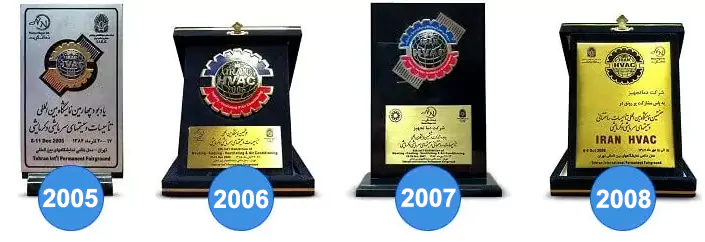
DamaTajhiz HVAC Corporation Participation at International HVAC and Construction Facilities Exhibitions Demonstrates its Global Reach and Commitment to the Industry.
We Look Forward to Your Call and the Opportunity to Meet You
SHARE THIS CONTENT TO SPREAD THE KNOWLEDGE
 |
 |
 |
 |
 |







Head Office: No. 463,Talebian Alley,Taleghani St.Tehran,Iran

DamaTajhiz has provided the opportunity to sell and ship specialized HVAC equipment for applicants in the following countries as the first and the most popular online store for selling HVAC equipment (Heating , Ventilation , Cooling , Air conditioning) in the Middle East : Afghanistan – Tajikistan - Uzbekistan – Turkmenistan – Azerbaijan – Armenia – Georgia – Turkey – Iraq – Syria – Jordan – Kuwait – Emirates – Qatar – Oman.


