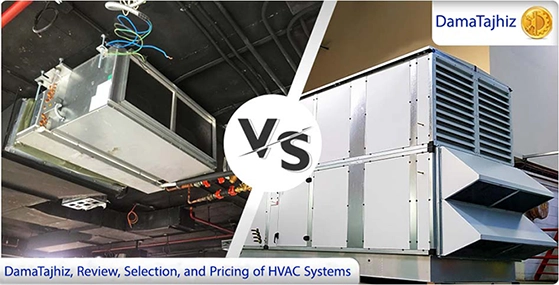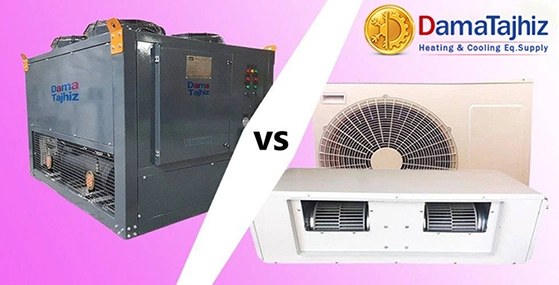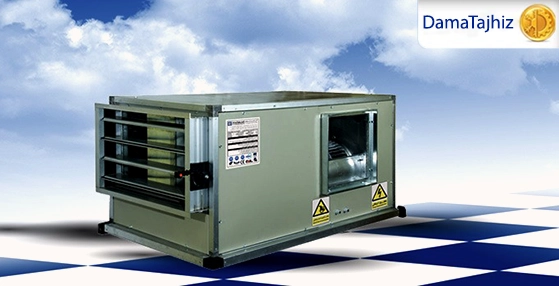
Air handling units (AHUs), regardless of capacity, are generally divided into three main types: Standard AHUs, Hygienic AHUs, and Heat Recovery AHUs. This blog post compares these three main types of air handling units to help you better understand how each one works. Meanwhile, please note that each type of AHU comes in various models, depending on factors such as the fan type, case material, having or not having humidity control components, and the type of coil (water or DX).

In every building, across different seasons, key parameters like temperature, humidity, and air filtration need to be controlled. That’s why air handling units are a vital part of HVAC systems. However, AHUs don’t produce heating or cooling by themselves; actually, they rely on cold and hot water coils, which are connected to systems like boilers and chillers. These coils condition the air, and the AHU distributes it throughout the building. Sensors within the AHU help monitor and control these air quality parameters, and the treated air is distributed via duct networks to individual units.
Standard Air Handling Unit
Standard air handling units are the most general type. The key features of standard AHUs include standard filtration (G4, M5, or F7 filters), simple access panels, cooling and heating coils (DX or chilled/hot water), typically coming in floor-mounted or ceiling-suspended, and being common in offices, malls, schools, etc.
Types of Standard Air Handling Units
Standard AHUs come in different types. Here are the types of standard air handling units, divided by four factors of Fan Type, Case Material, Coil Type, Humidity Control Equipment, Air Damper, and Fan Motor Type.
Standard AHUs Based on Fan Type
Based on their fan types, standard AHUs are classified into two categories:
- Draw-Through AHU
- Blow-Through AHU
In a draw-through AHU, the fan pulls air through the coils and mixing box, then pushes it into the duct system. These units can be installed either horizontally or vertically. In this type, the area before the fan is under negative pressure due to the suction effect.
In a blow-through AHU, the fan pushes air through the coils. In this setup, the section after the fan is under positive pressure. To ensure smoother airflow in this design, the space between the fan and the coil must be increased. This leads to a longer unit length and slightly higher cost compared to draw-through models.
Additionally, airflow over the coils in blow-through units tends to be more turbulent, causing greater temperature variation across the coil surface.
When fresh air intake is required, draw-through models are more practical since there is more room before the fan, making it easier to install a fresh air damper or inlet.
Review, Selection, and Pricing of HVAC Equipment
Types of Standard Air Handling Units Based on Coil Type
In some buildings, instead of using cold and hot water coils connected to a chiller or boiler, the AHU is linked to a four-season heat pump system. Examples include air-cooled chillers, VRF systems, or GHP systems.
These systems operate based on a vapor-compression refrigeration cycle, using refrigerants like R-134A, along with a heat pump. In fact, in DX-type AHUs, the cooling/heating system (such as a GHP or VRF) is integrated directly inside the AHU.
In this setup, the refrigerant flows directly into the DX coil inside the AHU, and this coil cools or heats the air. In another configuration, if an air-cooled chiller is connected directly to the AHU without a chilled water loop, the system is called a rooftop package unit or packaged unit.
Types of Standard Air Handling Units Based on Case Material
The frame of an AHU can vary depending on its use. It may be made of stainless steel, galvanized steel, or aluminum, with the appropriate thickness and strength for durability.
Types of Standard Air Handling Units Based on Fan Motor Type
The electric motor connected to the fan can either be a standard motor or an inverter-type motor, which helps reduce electricity consumption. The fan and motor connection may be direct-drive, belt-driven, or gear-driven, depending on the design.
Types of Standard AHUs Based on Humidity Control Equipment
Some AHUs include humidity control systems, while others do not. There are also different types of humidity control equipment. For example, cold water coils can reduce humidity in summer by condensing moisture from the air.
If a building project requires precise humidity control throughout the year, the AHU must include both humidifiers and dehumidifiers, especially for winter use.
Types of Standard Air Handling Units Based on Air Damper
Normally, AHUs have three air dampers:
- One for fresh air intake from outside
- One to supply air into the ductwork
- One to return air from inside the building
If the unit is designed to use 100% outside air, and the return air damper is removed, it’s called a Full Fresh Air AHU (or simply, “Full Fresh”).
Your source for selecting and purchasing ventilation and HVAC equipment (Since 2004)
Hygienic Air Handling Unit
Hygienic air handling units are commonly used in high-sensitivity environments such as operating rooms, clean rooms, hospitals, pharmaceutical and food industries, and laboratories. These AHUs include a built-in heat recovery system to reduce energy consumption by transferring heat between exhaust and fresh air. The main specifications of hygienic AHUs are as follows:
- Being equipped with plate heat exchangers or rotary heat recovery wheels
- Significantly improving energy efficiency (up to 60–80% recovery)
- Availability in both compact and modular formats
- Combinable with enthalpy recovery for humidity transfer
- Being often integrated with BMS systems
The key difference between a hygienic AHU and a standard AHU lies in the type of filters used and the airtight sealing of all joints and access panels to prevent any contaminants from entering the building.
Types of Hygienic Air Handling Units
Hygienic or cleanroom AHUs come in four main classifications as follows:
Modular Hygienic AHU
Modular cleanroom or hygienic AHUs are designed with a modular structure for easy assembly and disassembly, making them ideal for cleanroom environments. Also, they are best known for their optional integrations include high-efficiency filters, UV lamps, stainless steel coils, and more.
HEPA-equipped Cleanroom Air Handling Units
HEPA-equipped cleanroom air handling units are equipped with HEPA or ULPA filters for high-grade air filtration. Moreover, they are mandatory in operating rooms, pharmaceutical production, and medical-grade facilities where ultra-clean air is essential.
Double Skin Hygienic AHU
Double skin hygienic AHUs are built with a double-skin cabinet featuring thermal and acoustic insulation and seamless hygienic joints. They also have internal surfaces that are smooth and antibacterial, ensuring compliance with strict hygiene standards.
Ceiling-Mounted Hygienic AHU
Ceiling-mounted hygienic AHUs are compact in design, suitable for installation above false ceilings, making them perfect for space-constrained environments like labs and diagnostic rooms.
Heat Recovery Air Handling Unit
To recover energy from the exhaust air and transfer it to the fresh incoming air, AHUs require a simple heat exchanger. Based on this, air handling units are divided into two types: those with and without heat recovery systems. Heat recovery AHUs are also called Energy Recovery AHUs. They include a built-in heat recovery system to reduce energy consumption by transferring heat between exhaust and fresh air.
In summer, when the system is in cooling mode, cold air is supplied to the building, and the return air from the building—cooler than the outside air—passes through a heat exchanger.
In the heat recovery AHUs' working mechanism, the return air transfers some of its energy to the warmer incoming air from outside, which slightly reduces its temperature. This pre-cooled air requires less energy to cool down further, and the system recovers some of the cooling energy that would otherwise be wasted. This improves efficiency and saves energy. The most common highlights of energy recovery air handling units are:
- Equipped with plate heat exchangers or rotary heat recovery wheels
- Significantly improve energy efficiency (up to 60–80% recovery)
- Available in both compact and modular formats
- Can be combined with enthalpy recovery for humidity transfer
- Often integrated with BMS systems
Types of Heat or Energy Recovery AHUs
Heat recovery AHUs are typically designed in four types, briefly described in the following.
Plate Heat Exchanger AHU
Plate Heat Exchanger AHUs utilize aluminum plate heat exchangers to transfer heat between incoming fresh air and outgoing exhaust air without transferring moisture, providing dry heat recovery.
Rotary Heat Recovery Wheel AHU
Rotary Heat Recovery Wheel AHUs are equipped with a rotating wheel made of aluminum or enthalpy materials that transfer both heat and moisture between the two air streams. These units offer high efficiency and are particularly suitable for dry climates.
Run-Around Coil AHU
Run-Around Coil AHUs consist of two separate heat coils—one in the supply air stream and one in the exhaust air stream—connected by pumps and piping. This design is ideal for applications where direct mixing of air streams is not possible or permitted.
Enthalpy Wheel AHU
Enthalpy Wheel AHUs feature enthalpy recovery wheels that simultaneously transfer sensible heat and water vapor, making them especially suitable for climates where humidity control is critical.
Comparing Different Types of Air Handling Units in Brief
Air Handling Units (AHUs) come in several types tailored to specific HVAC needs: Standard AHUs serve general commercial and residential applications with basic filtration and straightforward design; Hygienic AHUs are specialized for environments demanding high air purity such as hospitals and cleanrooms, featuring smooth, antibacterial surfaces and HEPA filtration; and Heat Recovery AHUs focus on energy efficiency by recovering heat and sometimes moisture between exhaust and fresh air streams, using technologies like plate heat exchangers, rotary wheels, or run-around coils. Each type of air handling unit further divides into sub-models with distinct installation styles and features, such as modular or packaged units, ceiling-mounted designs, and advanced filtration options, allowing tailored solutions based on factors like air quality requirements, energy savings goals, spatial constraints, and zoning complexities.
Types of Air Handling Units Comparison Table
| Model | Main Category | Structure / Mounting | Energy Recovery / Filtration | Main Application | Key Feature |
|---|---|---|---|---|---|
| Draw-Through AHU | Standard AHU | Floor-mounted or modular | Basic filtration (F5–F7) | Offices, schools | Efficient air mixing |
| Blow-Through AHU | Standard AHU | Floor-mounted or suspended | Basic filtration | Industrial zones | Simpler design, low-pressure use |
| Single Zone AHU | Standard AHU | Floor-mounted or wall-hung | Basic filtration | Small buildings | Cost-effective and simple |
| Multi-Zone AHU | Standard AHU | Modular / custom | Independent zone dampers | Hospitals, malls | Controls multiple zones |
| Packaged AHU | Standard AHU | Factory-built compact unit | Basic filters + coil | Rooftops, prefabricated rooms | Plug-and-play, compact |
| Modular Hygienic AHU | Hygienic AHU | Modular, easy to dismantle | HEPA + optional UV | Cleanrooms, labs | Easy to assemble and sanitize |
| HEPA-equipped AHU | Hygienic AHU | Fixed or modular | HEPA or ULPA filters | Hospitals, ICUs | High-level air purification |
| Double Skin Hygienic AHU | Hygienic AHU | Double-wall insulated panels | HEPA + antibacterial surfaces | Food/pharma facilities | Hygiene-certified, corrosion-resistant |
| Ceiling-Mounted Hygienic AHU | Hygienic AHU | Suspended in false ceilings | Medium to high filtration | Small labs, surgical rooms | Space-saving hygienic unit |
| Plate Heat Exchanger AHU | Heat Recovery AHU | Floor or rooftop | Dry sensible heat transfer | Offices, residential | High-efficiency energy recovery |
| Rotary Wheel AHU | Heat Recovery AHU | Modular (horizontal/vertical) | Heat + moisture transfer | Airports, commercial centers | Enthalpy-based energy savings |
| Run-Around Coil AHU | Heat Recovery AHU | Dual coil + external piping | Sensible heat transfer | Separated airflows (labs, toxic zones) | No air cross-contamination |
| Enthalpy Wheel AHU | Heat Recovery AHU | Modular or rooftop | Heat + humidity recovery | Hotels, humid zones | Controls humidity and temperature together |
Frequently Asked Questions (FAQs) about Comparing AHUs
After reviewing all types of AHUs and comparing them, it is time to study frequently asked questions about comparing different kinds of air handling units.
1. What is the difference between a standard AHU and a hygienic AHU?
A standard AHU is used in general HVAC systems such as offices, malls, and schools. It includes basic filtration and standard construction.
A hygienic AHU, on the other hand, is designed for critical environments (like hospitals and cleanrooms). It features stainless steel or coated interiors, HEPA filters, smooth anti-bacterial surfaces, and easy-to-clean modular panels.
2. Which type of AHU is best for energy savings?
Heat Recovery AHUs (such as plate heat exchangers or rotary wheel types) are best for energy efficiency. They reuse the heat or humidity from exhaust air to pre-condition incoming fresh air, reducing HVAC energy demand by 30–70%.
3. Can I use a heat recovery AHU in a hospital or cleanroom?
Only in specific cases. Most hygienic AHUs do not integrate traditional heat recovery wheels due to contamination risks. However, run-around coil systems can be used for safe heat recovery without mixing airstreams.
4. Are modular AHUs better than packaged units?
Modular AHUs offer more flexibility and customization for complex HVAC needs (multi-zone, clean air, heat recovery, etc.).
Packaged AHUs are compact, factory-assembled, and easier to install, suitable for simple, small to medium-scale applications.
5. What type of AHU is best for areas with limited ceiling height?
Ceiling-mounted AHUs (available in both standard and hygienic forms) are specifically designed for spaces with low ceilings. They are compact and suspended in the false ceiling without compromising airflow or filtration quality.
6. Is there an AHU that can provide both cooling and energy recovery?
Yes. Most heat recovery AHUs include cooling and heating coils and can be connected to chillers or heat pumps. They also recover energy through plate or rotary heat exchangers to improve efficiency.
7. How do I choose the right type of AHU for my building?
It depends on several factors:
- Indoor air quality requirements: using hygienic AHUs for clean zones
- Energy efficiency goals: use heat recovery AHUs
- Space constraints: ceiling-mounted or packaged AHUs
- Zoning needs: multi-zone AHUs
- Installation time: Packaged AHUs are faster to deploy
Up until here, you studied all types of air handling units and their comparison in all details. On the DamaTajhiz specialized website, you’ll find technical specs and details for dozens of AHU models from top brands, all with original warranties. So, with DamaTajhiz Air Handling Units, you can enjoy a smart, reliable, and optimized purchase.
You can explore and order various types of AHUs and air washers for your project at the best price and with full warranty, directly from DamaTajhiz.

We are waiting for your call and look forward to meeting you at the DAMATAJHIZ group
By sharing the above article on social networks, let your friends know about its important content.