As you know, most industrial processes and HVAC systems generate heat, and this heat needs to be removed from the system somehow. Since water has a high specific heat capacity, it is the best medium to carry away this heat.
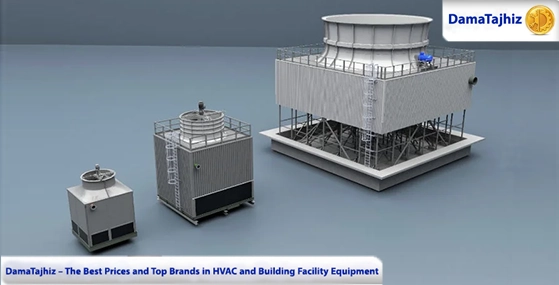
The cooling tower is a special type of heat exchanger that cools the water circulating in the condenser by using air through evaporative cooling. Cooling towers are widely used in various shapes and sizes in building HVAC systems, power plants, refineries, and different industries (based on heat transfer via mass transfer), ranging from small rooftop models for residential buildings to very large structures (up to 200 meters high and 100 meters in diameter), often hyperboloid-shaped in power plants and large industries. Stay with us as we explain their applications.

Cooling Tower Applications in Central HVAC Systems
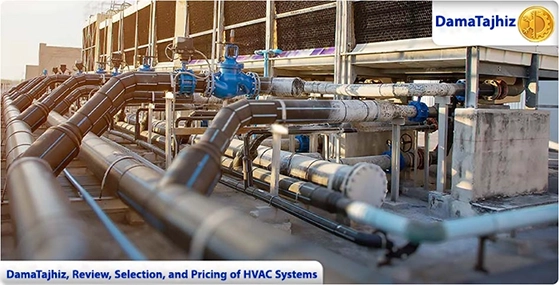
To provide cooling water for the refrigerant in HVAC systems that use water absorption or compression chillers as cooling sources, another source must be designed in the system to cool the chiller’s refrigerant. This device, which cools the condenser of absorption and water compression chillers, is the cooling tower. In most residential and office buildings with central heating and cooling systems, the cooling tower can be seen on their rooftops.
The efficiency of cooling towers depends on the water flow rate, the inlet and outlet water temperatures of the cooling tower, and the wet-bulb temperature (WB) of the air during summer. Therefore, it is recommended to consider all design principles before purchasing and installing a cooling tower. Watch the video below to learn more about how cooling towers work.
Cooling Tower Applications in Power Plants
Most of the electrical energy required by humans is supplied by thermal power plants. These plants usually use superheated steam as the working fluid to drive turbines and generate electricity, which requires cooling through various processes. Due to the extensive cooling needs in power plants, huge cooling towers are used, with heights up to 200 meters, diameters of 100 meters, and water flow rates up to fifty thousand cubic meters per hour. In these cooling towers, due to the critical and strict requirements of power plants, they must operate reliably and steadily at all times.
The main difference in thermal power plant design is the type of fuel used. Thermal power plants use superheated steam and high-pressure water from burning fossil fuels (like oil, coal, and natural gas), nuclear energy, or renewable energies (like solar and geothermal) to drive turbines. The hot water, after turning into superheated steam, goes to the turbine connected to a generator, turning it by its kinetic energy. After passing through the turbine, the steam enters the condenser, where the power plant cooling tower lowers the steam temperature, turning it back into condensate water. In general, cooling towers are used in all thermal power plants to cool the steam coming out of the turbine in the condenser.
Review, Selection, and Pricing of HVAC Equipment
Cooling Tower Applications in Industry
Cooling towers are used in various industries such as petrochemicals, steel, food industries like dairy, paper production, pharmaceuticals, automotive, wood, cement, paint and resin, plastic injection molding, glass and ceramics, and more.
The main role of cooling towers in industries is to regulate the temperature of heat sources and heavy machinery like injection machines and induction furnaces. For example, an induction furnace requires heat exchange with the outside environment after a melting process. Naturally, the surrounding air cannot transfer such a large amount of heat energy without water. Water, with its very high specific heat capacity, makes this possible and returns to the cooling tower after absorbing the heat for recovery.
Also, in the plastic injection industry, during a plastic injection cycle, the mold section must be cooled within a set time for the product to form. Cooling the mold and circulating oil inside the injection machine is done using an industrial cooling tower or a water chiller.
Use of Cooling Towers in the Oil and Petrochemical Industry
In a crude oil refinery, where cooling (distillation) is the main process, the oil is cooled step-by-step in the distillation tower. The crude oil temperature sometimes rises above 400 °C, and cooling water is used to cool the oil in the distillation tower. The cooling water required for the distillation tower is provided by the cooling tower.
DamaTajhiz: Best Prices and Brands of HVAC Systems
Final Words
In this article, we described some applications of cooling towers and hope the information was helpful. You can visit DamaTajhiz’s specialized website (the first and most trusted specialized center in building installation equipment and HVAC systems since 2004, with 3 valid business licenses) to see and compare various cooling towers by DamaTajhiz and other reputable brands with different brands and capacities, and check the latest prices. For more information and consultation, you can contact DamaTajhiz experts during business hours.
"Knowledge Fuels Better Choices"
Registered Trademark and Stewardship Business Licenses Issued by the Union of Virtual Business Association and the HVAC Equipment Industry.
DamaTajhiz HVAC Participation at International HVAC and Construction Facilities Exhibitions Demonstrates its Global Reach and Commitment to the Industry.
We Look Forward to Your Call and the Opportunity to Meet With You
SHARE THIS CONTENT TO SPREAD THE KNOWLEDGE
| |