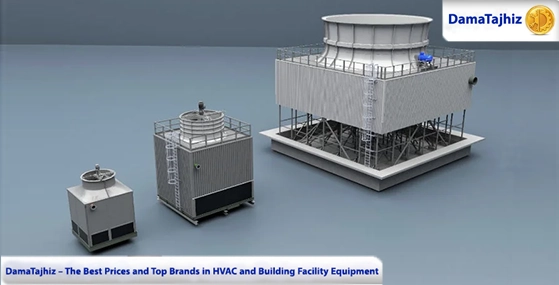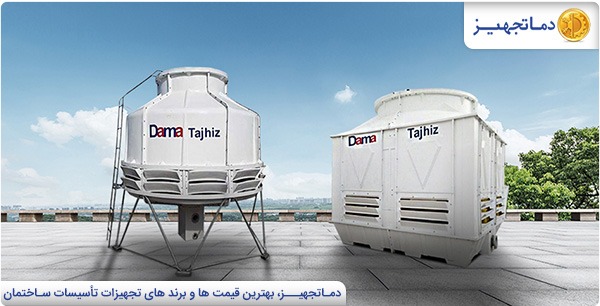
As you know, cooling towers are a type of heat exchanger that cool the circulating water of condenser systems in air conditioning, industrial processes, power plants, refineries, and various industries. It is also known that cooling towers are divided into two types: open circuit (wet) and closed circuit (dry). Open-circuit (wet) cooling towers are more widely used because of their better performance and efficiency. Considering the water consumption of these devices and the water scarcity issue in Iran’s relatively dry climate, one challenging topic when using open circuit (wet) cooling towers is the amount of water consumption and the factors affecting water loss, which we will discuss below.

Water Loss in Cooling Towers
The water consumption of a cooling tower falls into three categories: evaporative loss, blowdown loss, and drift loss (water droplets carried away by air). Most of the water loss is due to evaporation and then blowdown, with a smaller portion due to water droplet drift, which we explain below.
Evaporative Water Loss in Cooling Towers
E=0.0015×R×C
E: Evaporated water volume (cubic meters per hour)
R: Temperature difference between cooling tower inlet and outlet water (°C)
C: Circulating water flow rate (cubic meters per hour)
Second formula to calculate evaporated water in the cooling tower:
E=0.0018×R×C
In this formula, E, R, and C have the same meanings as in the first one. The only difference is the coefficient: 0.0015 in the first formula and 0.0018 in the second, because the ratio of evaporation to circulating water flow is approximately 0.0015 to 0.0018 times the flow.
Meaning:
E/C = 0.0015 ~ 0.0018 × R
For example, if the cooling tower inlet temperature is 40 °C and the outlet temperature is 30 °C, the temperature difference is 10 °C. If the circulating water flow rate is 50 cubic meters per hour, then the evaporated water volume is 750 liters per hour or 0.75 cubic meters (using the 0.0015 coefficient). The evaporation ratio to circulating water is 0.015.
To control cooling capacity, the outlet water temperature can be monitored and adjusted. Intelligent control systems adjust the cooling tower fan speed based on outlet water temperature, changing the air flow rate inside the tower. This helps reduce water consumption as much as possible. In general, any action that improves cooling tower efficiency reduces evaporation and water consumption.
Review, Selection, and Pricing of HVAC Equipment
Blowdown Water Loss in Cooling Towers
After some time of evaporation, the concentration of dissolved solids (TDS) in the cooling tower basin increases. Therefore, some basin water must be drained and replaced with fresh make-up water to keep deposits and ion concentration stable. This water loss is called blowdown.
To reduce blowdown loss, using low-mineral or treated water is recommended. This can be done by installing water softeners or reverse osmosis (RO) systems in the incoming water line.
Drift Water Loss in Cooling Towers
Another factor causing water loss is the spray of water droplets outside the tower. When air leaves the cooling surfaces and meets water from nozzles, droplets change direction at the top of the tower and exit the unit. To reduce this loss and water consumption, drift eliminators are used in the air inlet and outlet paths.
The cooling tower location should also be chosen to minimize wind exposure, as strong winds increase water droplet drift.
It is worth noting that drift loss depends heavily on the cooling tower’s design and build quality.
DamaTajhiz; The best prices and brands of building installation equipment
Final Words
This article reviewed water consumption and reasons for water loss in open-circuit (wet) cooling towers. We hope the information was helpful. When selecting HVAC equipment, such as cooling towers, calculating capacity and water consumption is essential. For more information and consultation, please contact DamaTajhiz experts during business hours. You can also visit DamaTajhiz cooling towers in the specialized website to compare different cooling tower brands and capacities and get updated prices. Damatajhiz is the first and most reputable specialized provider in building installation equipment and HVAC systems since 2004, holding 3 valid business licenses.
"Knowledge Fuels Better Choices"
Registered Trademark and Stewardship Business Licenses Issued by the Union of Virtual Business Association and the HVAC Equipment Industry.
DamaTajhiz HVAC Participation at International HVAC and Construction Facilities Exhibitions Demonstrates its Global Reach and Commitment to the Industry.
We Look Forward to Your Call and the Opportunity to Meet With You
SHARE THIS CONTENT TO SPREAD THE KNOWLEDGE
| |