It is vital for any building to be equipped with the right HVAC system. Despite the wide variety of available systems, deciding between a chiller and a ducted split air conditioner is not so challenging, because they are such different in most factors that you can easily select which you need. This article studies the features, advantages, disadvantages, and structural differences between ducted splits and chiller systems, and then guides selecting the most suitable option.
Ducted Split vs Chiller in Terms of Structure and Operation
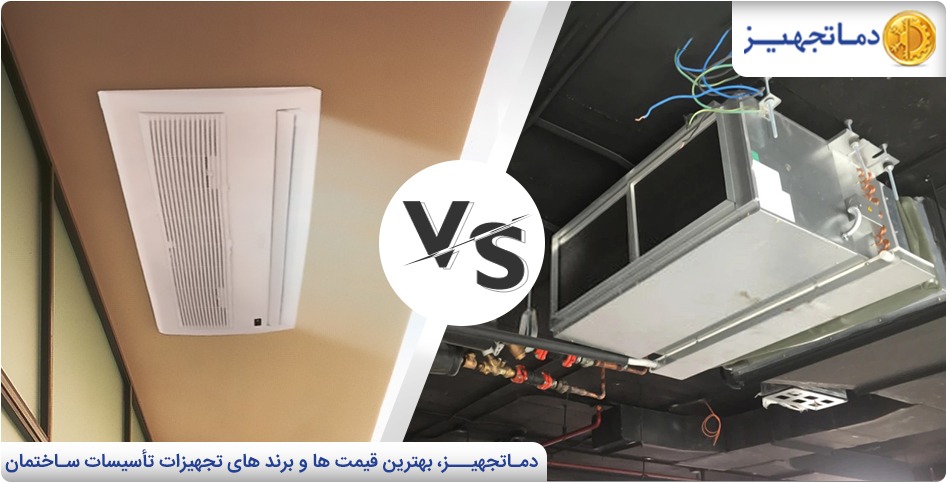
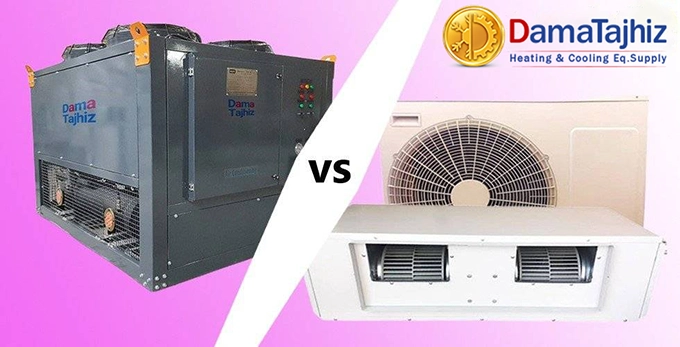
A chiller consists of a compressor, evaporator, condenser, and expansion valve. Refrigerant circulates through the system, producing chilled water in a continuous cooling cycle. This chilled water is pumped to the cooling coils of fan coils or air handling units. In some cases, the chiller directly sends refrigerant to the AHU, known as a DX coil system. Chillers typically provide building cooling in three ways: through fan coils, through AHUs, or as a packaged unit with a DX coil in air-cooled or mini chillers. Air passing over the coils is cooled by the fan.
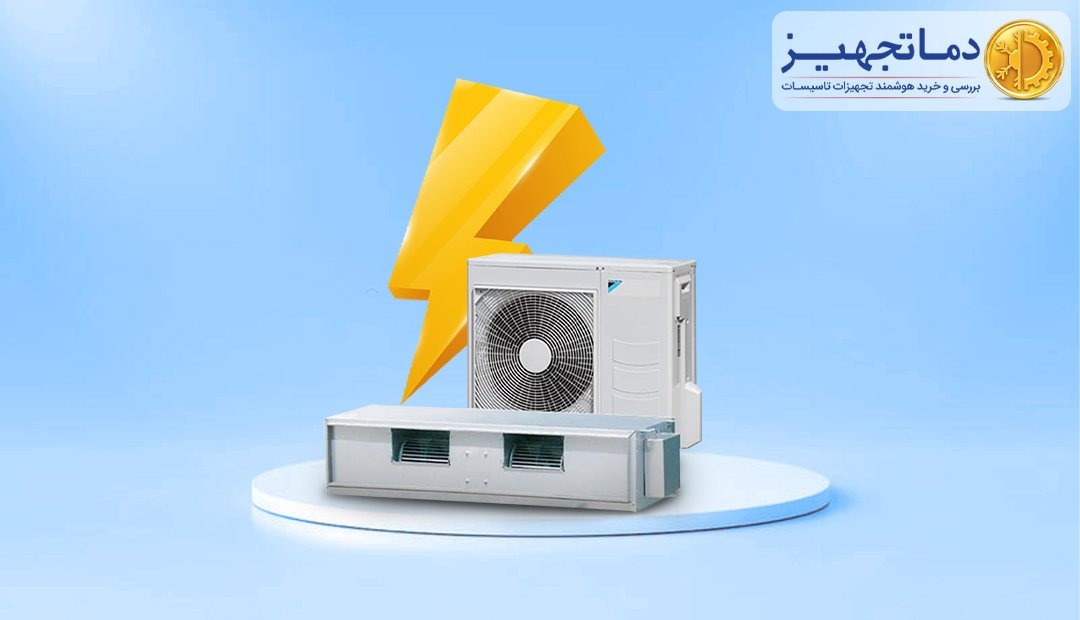
A ducted split air conditioner consists of two main parts: an outdoor unit (condensing unit) and an indoor unit. The outdoor unit contains the compressor and condenser and is connected to the indoor evaporator unit via piping. It is usually installed above a false ceiling. The refrigerant absorbs heat in the evaporator, cooling the air, which is then circulated into the space by a fan. Ducted splits are available in capacities ranging from 18,000 to 60,000 BTU and can be single-phase or three-phase.
Review, Selection, and Pricing of HVAC Equipment
Unit Independence in Ducted Split vs. Chiller
Chiller systems are centrally designed for the entire building, and a failure affects all units. Ducted split air conditioner systems are installed independently in each unit, so a malfunction in one device does not impact other units. Using a separate mini chiller for each unit also ensures independence.
Chiller vs. Ducted Split Temperature Control
Temperature control in a chiller system is possible via thermostats and fan coil adjustments, whereas in a ducted split system, controlling the temperature of individual rooms requires additional dampers in the ducts.
Ducted Split vs. Chiller in Heating Mood
Compression chillers and mini chillers are designed solely for cooling and require a separate system for heating. Ducted split systems, in addition to the cooling coil, include a hot water coil supplied by the central boiler or wall-mounted gas package. Fan coils can provide heating or cooling depending on the temperature of the water supplied. For ducted split systems, adding a dedicated hot water coil is necessary to enable hydronic heating.
Dehumidification and Air Filtration in Chiller vs Ducted Split
A key difference between ducted split systems and chillers is the ability to control humidity and air filtration. Ducted split air conditioners can only reduce humidity in cooling mode during summer and cannot increase humidity in winter. Chillers, when connected to an AHU or used as a packaged unit, allow the addition of humidification and dehumidification equipment, enabling precise control of indoor humidity year-round. Due to their smaller size and installation above the ceiling, ducted split evaporators have limited filter options, usually only two- or three-layer metal filters, while AHUs can accommodate various filters, including HEPA and ULPA, achieving higher air cleanliness.
Chiller vs Ducted Split in Cost, Power Consumption, and Noise
The final cost of chillers and ducted split systems is a significant factor in system selection. For buildings with up to 20 units, a central chiller with fan coils is roughly equivalent to a ducted split s air conditioner. For larger buildings, central chillers are more cost-effective. Using a mini chiller for buildings with fewer than 20 units can cost approximately 1.5 to 2 times more than a ducted split of similar capacity.
Regarding power consumption, despite the independence of each unit in ducted splits, chiller compressors, the largest energy consumers, mostly do not operate at full load. Thus, the total electricity cost for a central chiller system, distributed among all units, is about 30% lower than the combined cost of multiple ducted split air conditioners. Ducted splits generate more noise due to their powerful fans, whereas the outdoor units of both systems, located on rooftops, do not produce significant noise.
Comparing Chiller with Ducted Split Summary Table
For buildings with fewer than 22 units and areas under 120 square meters, independent ducted split air conditioners with a hot water coil and wall-mounted heating package are the most economical and convenient option. For larger units, using two smaller-capacity ducted splits is recommended to reduce noise and allow independent operation of living and bedroom areas. In larger buildings with multiple units, central chillers equipped with ceiling fan coils are more cost-effective and provide better cooling, heating, and humidity control. The following table shows all pieces of information at a glance.
| Feature | Central Chiller | Ducted Split |
|---|---|---|
| Capacity | High, suitable for large buildings | Medium, suitable for homes and apartments |
| Installation & Maintenance | Complex and costly | Simpler and more affordable |
| Energy Consumption | Lower for the entire building (per unit) | Higher when summed across units |
| Temperature Control | Adjustable for each room | Requires dampers for each room |
| Heating | Requires a separate system | Possible with an internal hot water coil |
| Dehumidification | Can add equipment to increase or reduce humidity | Reduces humidity only in summer |
| Air Filtration | Various filters can be installed | Limited to simple metal filters |
| Noise | Low | Higher due to a powerful fan |
| Unit Independence | Centralised, failure affects all units | Independent, one unit failure does not affect others |
DamaTajhiz: Thousands of products for thousands of projects (since 2004)
The choice between a central chiller and a ducted split air conditioner depends on the building’s size, number of units, floor area, budget, and heating/cooling needs. Central chillers are ideal for large buildings and industrial projects with high cooling demand, while ducted splits are suitable for medium-sized buildings, independent units, and projects requiring quick installation and lower maintenance costs.
You can order any HVAC and MEP products, including different types of air washers, cooling towers, air handling units, chillers, industrial evaporative coolers, air curtains, burners, cast-iron or steel boilers, heat exchangers, gas heaters, unit heaters, circulation pumps, sand filters, water and fuel storage tanks, and more, from countries such as the UAE, Armenia, Tajikistan, Georgia, Azerbaijan, Turkey, Oman, Pakistan, Turkmenistan, Afghanistan, Iraq, and others across Asia, the Middle East, and Europe, and have them delivered to your city in the shortest possible time.
For more information, including a free professional consultation, please contact DamaTajhiz Engineering & Manufacturing Company experts at: +98-930-288-0251. For convenience, you can also click the WhatsApp button to send a text or voice message and receive guidance and advice directly via WhatsApp.
"Knowledge Fuels Better Choices"
Registered Trademark and Stewardship Business Licenses Issued by the Union of Virtual Business Association and the HVAC Equipment Industry.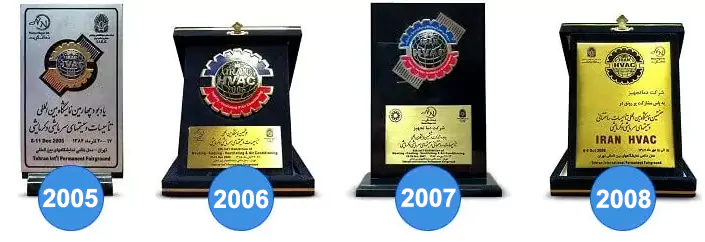
DamaTajhiz HVAC Participation at International HVAC and Construction Facilities Exhibitions Demonstrates its Global Reach and Commitment to the Industry.

We Look Forward to Your Call and the Opportunity to Meet With You
SHARE THIS CONTENT TO SPREAD THE KNOWLEDGE
 |
 |
 |
 |
 |