
Coiled Tank
If you are planning to select and purchase a coil water heater storage tank for domestic hot water production, below you'll find guidance on capacity sizing and 9 important technical considerations for selecting a coil water heater storage tank.
Expert Guide to Choosing and Pricing Coil Water Heater Storage Tanks
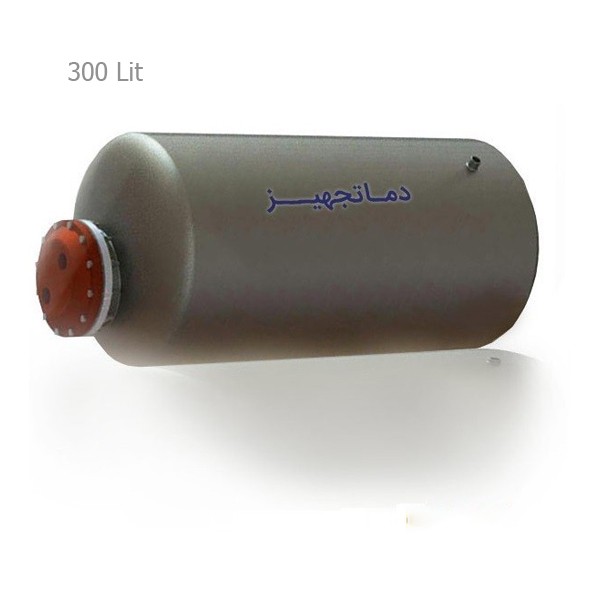
A coil water heater storage tank consists of a galvanized cylindrical tank equipped with one or more copper heating coils. These domestic hot water storage tanks are manufactured in both horizontal and vertical configurations, with capacities ranging from 300 to 6,000 liters.
In a coil water heater storage tank, incoming cold water is heated inside the galvanized tank through indirect heat transfer from hot boiler water circulating inside the copper coil. For this reason, coil water heater storage tanks are widely used to provide domestic hot water in residential, commercial, and industrial applications.
A coil water heater storage tank is equipped with two water inlet and two water outlet connections. One pair is connected to the storage tank, while the other serves the copper heating coil. Compared with double-wall storage tanks, coil water heater storage tanks provide higher efficiency and faster domestic hot water production thanks to the larger heat transfer surface area of the copper coil.
9 Important Technical Considerations for Selecting a Coil Water Heater Storage Tank
When selecting a coil water heater storage tank, the following technical considerations should be taken into account:
- The tank end caps should be manufactured from alloy steel and feature reinforced flanged edges.
- To ensure structural strength, each storage tank should have an appropriate shell thickness based on its capacity, along with a durable stainless steel support base.
- Threaded couplings for the domestic hot water outlet, cold water inlet, drain valve, thermometer, pressure gauge, and safety valve should be securely welded to the tank.
- After cleaning the internal surface, all welded areas should be coated with two layers of specialized epoxy coating or cold galvanizing compound. The exterior surface should also be treated with anti-corrosion primer followed by an oil-based protective paint.
- The copper heating coil should be manufactured in accordance with ASME and BS standards.
- Each storage tank should be equipped with two lifting lugs to facilitate transportation and installation.
- Copper coils are typically manufactured using 3/4-inch or 7/8-inch copper tubing.
- For coil water heater storage tanks with capacities above 1,500 liters (upon customer request), a circular manhole is provided to allow access inside the tank for inspection and for applying epoxy or cold galvanizing coating to welded areas.
- If the lowest point of the heating coil in a horizontal storage tank is positioned above the hot water boiler header in the boiler room, domestic hot water can be supplied without the need for a hot water circulation pump.
Coil water heater storage tanks offer high thermal efficiency, easy maintenance and cleaning, flexible horizontal or vertical installation, and long service life, making them a superior choice compared to double-wall storage tanks.
The primary difference between a coil water heater storage tank and a double-wall storage tank lies in their internal construction. A double-wall tank consists of two concentric cylindrical tanks, whereas a coil water heater storage tank contains a single main tank fitted with one or more copper coils that transfer heat from the boiler water to the incoming cold domestic water.
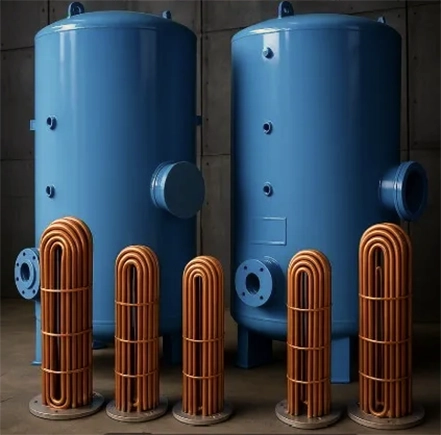
Types of Coiled Water Tanks
Coil water heater tanks are categorized based on their installation position, number of coils, tank material, and type of working fluid, as follows:
Types of Coil Hot Water Tanks Based on Installation Position
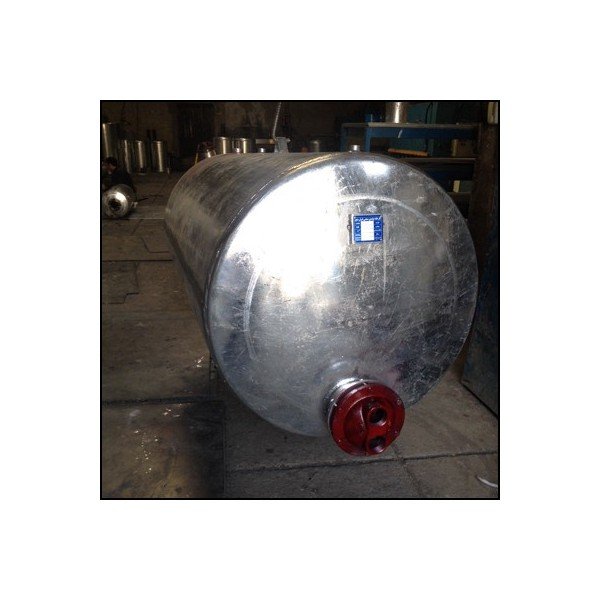
- Horizontal coil water tank
- Vertical (standing) coil water tank
Types of Coil Hot Water Tanks Based on Number of Coils
- Single-coil water heater tank
- Double-coil water heater tank
Types of Coil Water Heater Tanks Based on Tank Material
- Coiled tank made of hot-dip galvanized steel sheet
- Coil tank made of black carbon steel sheet
Types of Coil Hot Water Tanks Based on Working Fluid
- Water-to-water coiled tank
- Steam-to-water coil tank
Differences Between Horizontal and Vertical Coil Water Tanks
In horizontal coiled tanks, the water cylinder is positioned horizontally (laid down) and can accommodate larger-sized coils. Therefore, using this type of tank is not suitable in areas with limited space.
Vertical (standing) coil tanks, on the other hand, feature an upright cylinder and are preferred in cases where floor space is limited. However, since larger coils cannot be installed inside vertical tanks, they have lower heating power and capacity compared to horizontal coiled tanks.
Main Components of a Coil Water Heater Tank
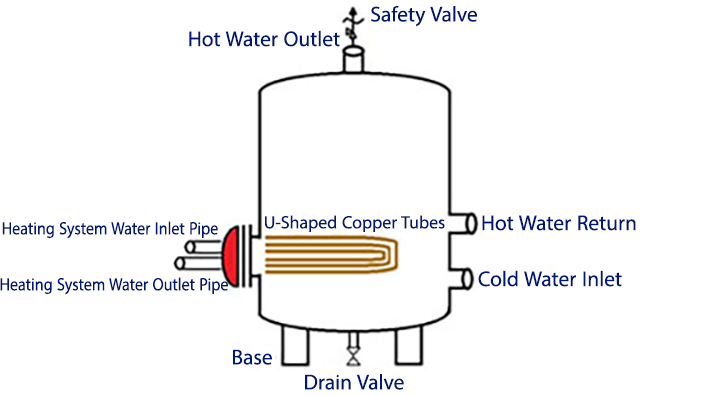
If you intend to purchase a coil-type water heater tank, you should know that this tank consists of components such as the main tank, coil, safety valve (temperature and pressure), supports, and drain valve, which are described as follows.
Tank
The most essential component of a coil-type hot water tank is the cylindrical tank, usually made of hot-dip galvanized steel that is resistant to pressure, corrosion, and scaling. The primary function of this tank is to store the cold water volume and the copper coils of the tank.
Coil
Another main component of a coil-type water heater tank is the coil, which consists of multiple U-shaped copper tubes with appropriate thickness and diameter, arranged neatly and systematically together.
The coils in coil-type tanks are responsible for transferring heat from the hot water received from the boiler to the cold water inside the tank.
Safety Valve (Temperature and Pressure)
In general, the function of safety valves is to control, reduce, and prevent excessive pressure in closed equipment and tanks, such as a coiled tank, ensuring stable pressure of the working fluid.
Drain Valve
At the bottom of the coil tank, there is a component called the drain valve, which is used for complete drainage of the tank during potential maintenance or repair operations.
DamaTajhiz HVAC Co.; Thousands of Products for Thousands of Projects Across the Middle East (since 2004)
Applications of Vertical and Horizontal Coil Water Tanks
Coiled tanks are widely used due to their numerous advantages.
The advantages and applications of coil water heater tanks include:
- Residential projects, offices, and commercial buildings
- Factories, workshops, and industrial HVAC systems
- Worker camps (with central heating systems)
- Hotels and schools
- Swimming pools
Advantages of Coiled Water Heater Tanks
As a practical HVAC equipment for supplying domestic hot water, coil water tanks offer the following benefits:
- Durable and strong body, resistant to environmental conditions, with long service life
- Higher operational efficiency due to the presence of the coil (or heat exchanger) inside
- Ease of maintenance due to single-wall design (in case of leaks)
- Faster water heating inside the tank due to the use of copper heating coils with sufficient heat transfer surfaces
Note: The body of coil tanks is usually made of hot-dip galvanized steel. Therefore, if black steel sheets are used, the internal surface is fully coated with epoxy paint to prevent rust and oxidation.
Technical Points for Choosing a Coil Water Heater Tank
When selecting a coil-type water heater tank, attention should be paid to the following important technical points:
- For coiled tanks with a capacity greater than 1500 liters (upon customer request), a circular manhole, known as a "manhole cover," is provided for internal access and potential maintenance, such as applying epoxy inside the tank.
- The design temperature considered for the coils is 350°F.
- Each coil water heater tank must have appropriate supports made of structural steel for stability and proper installation.
- Necessary bushings for hot water outlet, water inlet, drainage, thermometer, thermocouple, thermostatic valve, pressure gauge, and safety valve should be welded to the coiled tank.
- After cleaning the internal surface of the tank, at least two layers of special epoxy paint are applied. After anti-corrosion treatment of the external surface, oil-based paint is used.
- The copper coil must be manufactured according to ASME and BS standards.
- For ease of handling, each tank is equipped with two dedicated hook points for lifting and transportation.
- For coil manufacturing, copper tubes with diameters of 3/4 inch or 7/8 inch are usually used.
- The end cap of the coiled tank must be made of alloy steel and must be flanged.
- If the lowest part of the coil in a horizontal coil tank is above the boiler collector level, domestic hot water supply can be achieved without using a circulation pump.
DamaTajhiz & Co.; Guide to Choosing and Buying HVAC Systems in the Middle East (Since 2004)
How a Coil Water Heater Tank Works
The coil water heater tank is a vessel designed to provide and store the domestic and sanitary hot water required in buildings and industrial facilities. These tanks also function as a type of coil or tubular heat exchanger, transferring heat from the hot water inside the coil to the cold water in the tank, thereby heating the tank water and supplying the needed hot water.
The coiled tank provides domestic and sanitary hot water indirectly.
The operation of a coiled tank is such that hot water or steam from the boiler enters the copper tubes (coil) inside the tank. As the flow passes through, the temperature of the coils rises and transfers its heat to the cold water inside the tank. In this way, the hot water required for the project is provided without mixing boiler water with the potable water.
Practical Note: In projects where the boiler room is located on the roof of the building, to prevent air locks in the hot water outlet of vertical coiled tanks, it is recommended to install the hot water outlet bushing on the cylinder slightly below the weld of the top end cap, instead of using the top end cap itself Additionally, a branch from the top of the end cap should connect to a diaphragm tank designed to collect excess air from the coil water heater tank, as the top safety valve of coil tanks may get clogged over time and fail to release excess air properly.
Buying a Coil Water Heater Tank
When selecting and purchasing a coiled tank as one type of hot water tank, it is crucial to pay attention to two parameters: tank volume and coil heat exchange surface area.
To purchase a coil water heater tank, you must first determine the desired capacity and type of tank (vertical or horizontal).
At DamaTajhiz HVAC Co., technical information about various coiled tanks from reputable brands with original warranties is provided to ensure an optimal and informed purchase experience.
Important Note: When selecting and ordering a coil tank, besides capacity, coil heat surface, thickness, and tank material, special attention must be given to the diameter and length of the tank for passage through the boiler room door and proper installation at the intended location. Once a coiled tank is manufactured, it cannot be returned.
DamaTajhiz & Co.; Providing HVAC Systems and Equipment Across the Middle East (since 2004)
Coiled Tank Price
The main factors determining the price of a coiled tank are tank capacity, type and number of coils, and tank material, which are key elements in the pricing of a coil water heater.
All prices for vertical and horizontal coil tanks provided by DamaTajhiz HVAC Co. are up-to-date, including special discounts for consumers. Therefore, we guarantee that these prices are the best and most competitive for high-quality coiled tanks with original warranty.
Updated Coiled Tank Price List
Dear users, in this section you can view the latest Coiled Tank Price List for November 2025 from top-selling and trusted brands such as Araz Sanat, Khazar Boiler, and DamaTajhiz & Co., and enjoy special discounted prices.
The following table presents the technical specifications and prices of different horizontal and vertical coiled tanks with various capacities from each brand.
Before purchasing a coil-type tank, we recommend contacting the technical experts at DamaTajhiz HVAC corporation to receive free professional consultation, verify suitable pricing, and review detailed technical specifications.
The technical table below lists various vertical and horizontal coil tanks by DamaTajhiz, Khazar Boiler, and Azar Sanat, along with their capacities and prices.
| Coiled Tank Brand | Type | Coiled Tank Capacity (liters) |
Price (USD) |
|---|---|---|---|
| Damatajhiz & Co. | Horizontal | 300–2000 | From 210 to 1033 |
| Damatajhiz & Co. | Vertical | 400–6000 | From 287 to 1487 |
| Khazar Boiler | Vertical | 1000–5000 | Contact for price |
| Araz Sanat | Vertical | 2500–3000 | Contact for price |
Coil Water Heater Tanks Installation
A coiled tank has six inlets and outlets. Two inlets are for the boiler hot water, entering the coil from the top and exiting from the bottom. One inlet below the coil is designed for domestic water, which enters the coil after passing through a water softener.
The outlet for potable water is located at the highest point to ensure natural convection allows water supply to residents even if the pump fails.
Additionally, an air vent valve should be installed on top of the tank, on the upper end cap below the hot water outlet, to enable air release when necessary. It is recommended to pipe from this point downwards so discharged water falls safely to the ground. Another drain valve should be installed at the bottom end cap for tank emptying during replacement.
A return path for hot water in the body, usually above or in line with the coil, is necessary. This return must also include a valve and a check valve.
Note: One critical point in operating coiled tanks (vertical and horizontal) is the need for complete insulation of the tank surface to prevent excessive heat loss and avoid overheating the boiler room air.

Effect of Anti-Scaling Devices in Coiled Tanks
Water hardness causes scale formation inside the coil of coil water tanks. Scale acts as an insulator, reducing heat transfer efficiency and overall performance of the coil. In such cases, a magnetic anti-scaling device can be used.
The anti-scaling device is installed on the cold water supply line to the coiled tank, generating a magnetic field that alters the structure of calcium and magnesium carbonate particles, preventing scale formation on the coil.
DamaTajhiz HVAC Co.; The Best Prices and Reputable Brands of HVAC Systems in the Middle East (since 2004)
Dear User;
Thank you for trusting the technical opinions of DamaTajhiz & Co. sales experts. Usually, the final choice of brand is based on experience, brand strength, services, and price by the buyer. However, for coiled tanks, most buyers prefer well-selling brands such as DamaTajhiz HVAC Co. due to their quality, price, and after-sales service.
You can order any HVAC and MEP products, including different types of air washers, cooling towers, air handling units, chillers, industrial evaporative coolers, air curtains, burners, cast-iron or steel boilers, heat exchangers, gas heaters, unit heaters, circulation pumps, sand filters, water and fuel storage tanks, and more, from countries such as the UAE, Armenia, Tajikistan, Georgia, Azerbaijan, Turkey, Oman, Pakistan, Turkmenistan, Georgia, Kuwait, Uzbekistan, Qatar, Iraq, and others across Asia, the Middle East, and Europe, and have them delivered to your city (Manama, Baghdad, Karachi, Dubai, Sharjah, Muscat, Riyadh, Abu Dhabi, Kuwait City, and Doha Amman, Sulaimaniyah, Kirkuk, Islamabad, Mosul, Erbil, Dushanbe, Aleppo, Damascus, Baku, etc.) in the shortest possible time. Furthermore, you can ask any question in the HVAC area of expertise and receive a free consultation from our professional team members by calling +98-930-288-0251 or sending a WhatsApp message to this number.
"Knowledge Fuels Better Choices"
Registered Trademark and Stewardship Business Licenses Issued by the Union of Virtual Business Association and the HVAC Equipment Industry.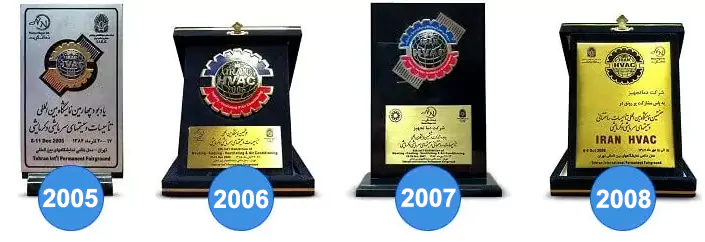
DamaTajhiz & Co. Participation at International HVAC and Construction Facilities Exhibitions Demonstrates its Global Reach and Commitment to the Industry.

We Look Forward to Your Call and the Opportunity to Meet You
SHARE THIS CONTENT TO SPREAD THE KNOWLEDGE
 |
 |
 |
 |
 |


Head Office: No. 463,Talebian Alley,Taleghani St.Tehran,Iran

DamaTajhiz has provided the opportunity to sell and ship specialized HVAC equipment for applicants in the following countries as the first and the most popular online store for selling HVAC equipment (Heating , Ventilation , Cooling , Air conditioning) in the Middle East : Afghanistan – Tajikistan - Uzbekistan – Turkmenistan – Azerbaijan – Armenia – Georgia – Turkey – Iraq – Syria – Jordan – Kuwait – Emirates – Qatar – Oman.


