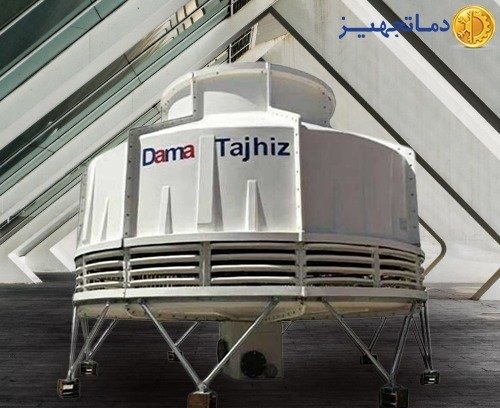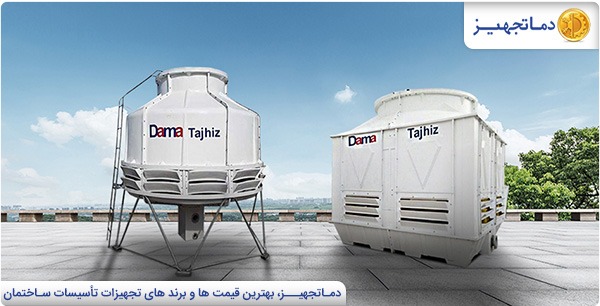
Cooling towers are a specialized type of heat exchanger where water and air come into direct contact to reduce the temperature of the water used in facilities or industrial systems. These systems come in various types depending on their construction, body shape and material, heat transfer method, air and water flow arrangement, and air suction method. Each type has its characteristics, limitations, and applications. Cooling towers are not only used in industries, refineries, and power plants but also in HVAC systems for residential and office complexes.

Since selecting the most appropriate type of cooling tower requires understanding the applications, advantages, and disadvantages of each type, this article examines the key applications, limitations, pros, and cons of major cooling tower types based on two key classification parameters: air and water flow arrangement, and air suction method.
Cooling Towers Types Based on Water and Air Flow
Cooling towers can be categorized by the flow configuration of water and air as follows:
Cross Flow Cooling Towers
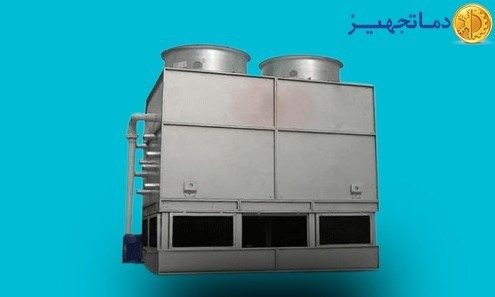
In a cross-flow cooling tower, water flows downward under gravity through perforated plates or nozzles, distributing it uniformly across the internal surfaces of the tower. Simultaneously, air enters the tower horizontally and is pulled outward by fans mounted outside the tower. This creates a perpendicular interaction between air and water. As some water evaporates, heat transfers from the water to the air.
The cooled water collects in the basin and is pumped to the necessary HVAC or industrial equipment.

Figure 1 — Cross Flow Cooling Tower
| Table 1 — Applications and Limitations of Cross-Flow Cooling Towers | |
Applications |
Air compression |
| Heat processing in the petrochemical industries | |
| Aluminum industries | |
Limitations |
Better performance in highly humid regions during warm seasons (northern and southern regions) |
| Manufactured in capacities above 2 MW; unsuitable for smaller applications | |
Cross Flow Cooling Towers Pros and Cons
Advantages:
- Lower fan power requirement and reduced operating costs
- Easy maintenance
Disadvantages:
- Water drifts inside the tower
- Ingress of debris into internal components
Counter Flow Cooling Towers
In a counter-flow cooling tower, the air moves vertically upward while the water falls downward through internal fill media. Air enters from the bottom and is pulled upward by the cooling tower fans suction. Water is sprayed through nozzles and flows downward, encountering the upward-moving air in a high-contact opposing direction. The critical design aspect is ensuring the water pressure overcomes the air velocity so that water continues downward.
These towers must be tall enough to allow proper water distribution and sufficient cooling time. Counter-flow towers typically offer higher thermal efficiency in low-humidity environments than cross-flow types. Most open-loop cooling towers used in facilities and industries are counter flow models.

Figure 2 — Counter Flow Cooling Tower
Applications and Limitations of Counter Flow Cooling Towers
- Applications: Refineries and petrochemical plants
- Limitations: Usable in all regions
Table 2 — Advantages and Disadvantages of Counter Flow Cooling Towers
|
Advantages |
Disadvantages |
|
Maximum contact between air and water |
High noise due to pressurized water spraying |
|
Lighter weight compared to cross-flow towers |
Heavier maintenance requirements |
|
Highest mass and heat transfer efficiency among all tower types |
Types of Cooling Towers Based on Airflow Draft Type
Cooling towers are classified based on the type of airflow draft as follows:
Natural Draft Cooling Towers
In natural draft cooling towers, air flows naturally from the bottom to the top due to temperature differences, which cause density differences between the warm air inside the tower and the cooler outside air. Water enters from the top of the tower and, after being sprayed inside the cooling tower through nozzles, comes into counterflow contact with the air, causing part of the water to evaporate and cool down. Over time, the air temperature inside the tower rises due to heat exchange with the incoming water, increasing the temperature and density difference between the inside and outside air, which strengthens the natural airflow draft.
Natural draft cooling towers, such as the tall cooling towers in power plants, are made of concrete, are large in size, and have high construction costs.

Figure 3 – Natural Draft Cooling Tower
Applications and Limitations of Natural Draft Cooling Towers
- Applications: Power plants and process industries, factories requiring large amounts of cooled water, and sensitive industries
- Limitations: Suitable for use in all regions
Table 3 – Advantages and Disadvantages of Natural Draft Cooling Towers
|
Advantages |
Disadvantages |
|
Low energy consumption |
High initial cost |
|
Low operation and maintenance cost |
Performance affected by atmospheric conditions and weather-dependent operation |
|
Safe and reliable operation |
Larger size compared to mechanical draft cooling towers |
Mechanical Draft Cooling Towers
In mechanical draft cooling towers, unlike natural draft towers, air is moved by one or more fans. The presence of fans allows for control over the airflow rate, providing greater stability under varying weather conditions. Mechanical draft cooling towers are further divided into two main types.
Forced Draft Cooling Towers
In forced draft cooling towers, the fan is located at the air intake at the bottom of the tower and pushes air upward. Water enters from the top of the tower and, through counterflow contact with the air and partial evaporation, gets cooled. However, placing the cooling tower fan at the air intake can cause recirculation of hot air back into the tower, reducing cooling efficiency compared to induced draft towers. Forced draft towers are often made of galvanized steel.

Figure 4 – Forced Draft Cooling Tower
Applications and Limitations of Forced Draft Cooling Towers
- Applications: Chemical and energy industries
- Limitations: Suitable for use in all regions
Table 4 – Advantages and Disadvantages of Forced Draft Cooling Towers
|
Advantages |
Disadvantages |
|
Easy operation and maintenance due to easy access to the fan and motor |
Poor circulation of heated air and its recirculation into the tower caused by high air intake velocity and low exhaust velocity |
|
Low construction cost |
Requires high fan power and produces significant noise |
|
Stable performance under varying weather conditions |
Risk of fan freezing in cold seasons due to its location at the air intake |
Induced Draft Cooling Towers
The difference between this type of tower and forced draft cooling towers lies in the fan placement, which is installed at the top of the tower. In induced draft cooling towers, fans are located at the air outlet, pulling air through the tower and directing it outside. Thus, air is drawn by the cooling tower fan from the lower inlets upward, while water enters from the top and is sprayed inside the tower. Due to the fan’s position, air exits at high velocity while entering at low velocity, which reduces air recirculation and return. Additionally, the fan's location at the warm air outlet provides good protection against mechanical equipment freezing. Induced draft cooling towers are highly efficient because of the greater contact area between water and air. Their capacity ranges approximately from 3 to 160,000 cubic meters per hour (15 to 700,000 gallons per minute). The induced draft, counterflow cooling tower is the most common type used in process industries and is capable of producing cooled water with a temperature just 1°C (2°F) above the ambient wet-bulb temperature.

Figure 5 – Cross Flow Induced Draft Cooling Tower

Figure 6 – Counter Flow Induced Draft Cooling Tower
Applications and Limitations of Induced Draft Cooling Towers
- Applications: Best performance in cooling units, chemical and food industries
- Limitations: Suitable for use in all regions
Table 5 – Advantages and Disadvantages of Induced Draft Cooling Towers
|
Advantages |
Disadvantages |
|
No recirculation of heated air back into the system due to design and operating mechanism |
Heavy maintenance and repair of fans, motors, and other mechanical parts due to exposure to moist air |
|
High efficiency |
High risk of corrosion |
|
Requires fans with lower static pressure and consumes less energy compared to forced draft cooling towers |
|
|
Compact footprint |
|
|
Lower noise levels compared to forced draft cooling towers |
|
|
Stable performance under various weather conditions |
Cooling Tower in Brief
In this blog post, you completely studied and comprehended everything you needed to know about all types of cooling towers. Now you can easily select the most proper type for your intended usage. If you need any technical advice before choosing a cooling tower or its components, we are here to guide you through the best options. DamaTajhiz cooling towers, as well as our other products, are specialized to offer you the highest quality. You can contact us via WhatsApp or call us at the direct phone numbers. It would be a pleasure to hear your voice.

We are waiting for your call and look forward to meeting you at the DAMATAJHIZ group.
By sharing the above article on social networks, let your friends know about its important content.