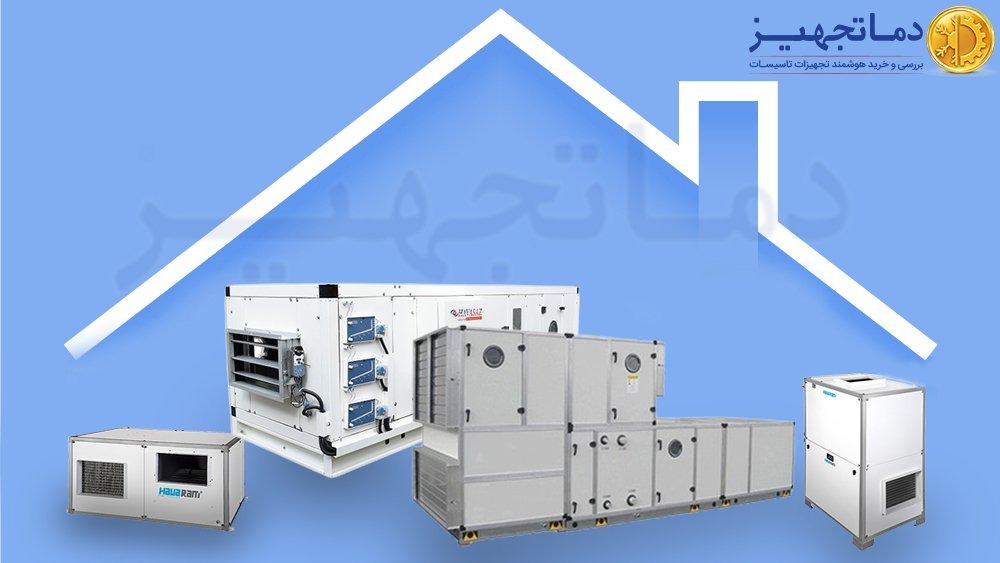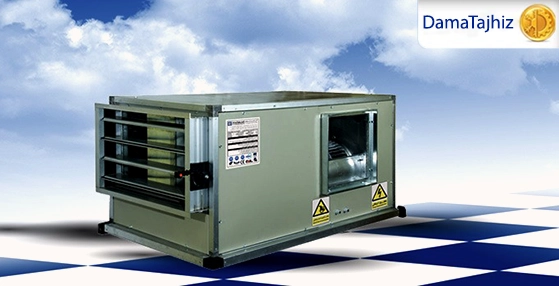
Air Handling Unit, also known as AHU or air handler, is one of the most practical appliances in HVAC (Heating, Ventilation, and Air Conditioning) systems. Its primary function is to supply, circulate, and condition fresh and clean air in the desired space. Therefore, it is widely used in public places, offices, commercial, and industrial facilities to provide ventilation, cooling, and heating. In this article, we will discuss the AHU unit, its types, functions, and applications.

What is an Air Handling Unit (AHU)?
In short, AHUs use chilled water from a central chiller during the summer to cool air via the cooling coil, and hot water from a boiler during the winter to heat air via the heating coil, delivering comfortable air throughout the building.
It's worth noting that this device is also referred to as an "air distributor" or "air transfer unit" because the term "weather maker" was previously used to translate AHU, even though the device itself does not generate air.
Features of Air Handling Units (AHUs)
Air handling units (air handlers) possess many features, and using them has many advantages, such as:
- High efficiency and performance
- Independent ventilation for each unit in a complex
- Space-saving installation on rooftops
- Air filtration and quality control
- Easy installation, maintenance, and repair
Review, Selection, and Pricing of HVAC Equipment
Air Handling Units Types
Generally, Air Handling Units are produced and offered in four main types for various applications, including:
- Hygienic AHUs
- Industrial AHUs
- Apartment AHUs
- Residential AHUs
Each of these types may come in variable air volume (VAV), variable temperature, or a combination of both (Full Fresh air or Return & Fresh Air), depending on the project's needs. The main purposes of all these models include:
- Temperature regulation
- Humidity control
- Air purification
- Fresh air supply
Hygienic Air Handling Units (AHUs)
Hygienic air handling units are considered the most advanced ones. Due to their high-efficiency filtration systems and sophisticated internal components, they are ideal for environments like hospitals and laboratories where sterile, dust-free, and contaminant-free air is vital. These units are designed and built based on specific international standards, which include:
- EN 1886 (Ventilation systems and their mechanical performance)
- VDI 3803 (Technical and structural standards for HVAC systems)
- VDI 6022 (Hygienic ventilation systems)
- EN 13053 (Performance and classification of HVAC system components)

Industrial Air Handling Units
Industrial AHUs are designed with larger structures and mechanisms to suit the needs of large spaces and facilities. These units are classified into the following main categories:
Industrial AHUs Classification by Airflow Type
- Full Fresh Air AHUs
- Return Air AHU units
Industrial AHUs Types by Airflow Rate
- Constant Air Volume (CAV) AHUs
- Variable Air Volume (VAV) AHUs
Industrial AHUs Classification by Air Distribution Zones
- Multi-zone air handlers (AHUs)
- Single-zone AHUs
These types of AHUs are commonly used in various environments such as industrial factories and workshops, seminar and conference halls, sports arenas, gyms, and more.

Air Handling Unit for Apartments
This type of AHU is used in apartment settings only when the design and installation requirements are fully met. In some cases, combining it with an air washer can reduce efficiency and even lead to the accumulation of bacteria and pollutants inside the AHU, which can then be released into indoor spaces.

Residential AHUs
Residential AHUs are specifically designed to provide heating and cooling for a single residential unit. It’s important to note that an air purifier is different from an AHU unit; while air purifiers only clean the air, they do not affect its temperature.
For smaller spaces, apartment air handling units are one of the most efficient solutions. Like other AHUs, they are designed to provide cool air in summer and warm air in winter, depending on their capacity. They also purify the air using appropriate filters to remove airborne pollutants.
Air Handling Units Components and Operation
Despite their high efficiency, AHUs have a relatively simple structure. They function in four main areas: cooling, heating, air filtration, and humidity control. Their components typically include heating and cooling coils, fans, air filters, humidifiers, ducts, etc. Hot or cold water generated by chillers, boilers, or a central plant is circulated through the unit’s coils. Then, one or more fans blow air over the coils to heat or cool them, which is then distributed through the building’s ductwork. In summer, chilled water flows through the coils for cooling, and in winter, hot water from the boiler enables heating.

Depending on the space and application, AHUs may vary in components, but the main parts include:
- Insulated and sealed housing
- Cooling and heating coil
- Air filters
- Blower fan and electric motor
AHU Cooling and Heating Coils
As mentioned earlier, AHUs adjust air temperature to meet heating or cooling needs. This is achieved through coils placed in the airflow path. Cooling coils can also act as dehumidifiers by lowering the air temperature below its dew point.
Coils are designed in two main types based on the project:
Air Handling Unit Direct Expansion (DX) Coils
These coils use refrigerant for cooling (DX Coil) and combustion gases (Fired Heater Coil) for heating. Heat pumps can also be used for direct heating and cooling. Another type includes electric heaters, which convert electricity into heat using built-in elements to warm the air.
Air Handling Unit Indirect Coils
These coils rely on chilled water (typically at 7°C) from a chiller for cooling and hot water (around 82°C) from a boiler for heating. Steam can also be used for indirect heating.
Air Handling Unit Filters
Filters are one of the most critical parts of an AHU. Selecting the correct type of filter has a direct impact on the unit’s performance. These filters come in different designs and are tested and classified based on international standards, including:
ASHRAE Standard of Air Handling Unit Filters
Stands for the American Society of Heating, Refrigerating, and Air-Conditioning Engineers.
EUROVENT Standard for Air Handling Unit Filters
Labelled with EU codes and used across European markets.
Common filter types used in AHUs include:
- ULPA filters
- HEPA filters
- Fiberglass pre-filters
- Bag filters
- Metal pre-filters
- Pleated panel filters
| Filtration Sensitivity | Filter Image | Filter Name | Filtration Sensitivity | Filter Image | Filter Name |
|---|---|---|---|---|---|
| 1mm | ![]() |
Metal Pre-filter | 1µm | ![]() |
Bag Filter |
| 5 - 10µm | ![]() |
Fiberglass Fiber Pre-filter | 0.3µm | ![]() |
HEPA Filter |
| 3 - 10µm | ![]() |
Flat Nylon Pre-filter | 0.12µm | ![]() |
ULPA Filter |
Air Handling Units Supply Fan
The supply fan is often referred to as the “heart” of the AHU. It generates the airflow needed to circulate air through the duct system by creating a pressure difference. Common fan types include centrifugal fans and plug fans.
It’s important to note that since fans are the main power consumers in an AHU, selecting an energy-efficient model significantly affects the system’s overall efficiency.
Air Handling Unit Selection Guide
As you know, with increased humidity, the enthalpy of the environment also rises. In other words, high humidity levels can make the temperature feel warmer. Due to the diverse climate zones across our country, air humidity levels vary significantly — reaching above 95% in some regions! Therefore, before starting any calculations, it is essential to analyze the type of application and the installation location of the air handling unit in terms of regional climate (humidity and temperature).
One of the most important factors in selecting an air handling unit is its airflow capacity. To calculate this specification, in addition to calculating the building's cooling and heating load, you must also consider the intended use of the AHU. For this reason, it is important to determine whether the selected AHU will be used for providing heating and cooling or simply for supplying fresh air. Thus, airflow capacity can be calculated in the following two ways:
Calculating Airflow Capacity for Project Heating and Cooling:
At this stage, the project's cooling and heating loads must be calculated by qualified and experienced HVAC engineers. The cooling or heating load of a building refers to the amount of energy lost or gained through walls, floors, ceilings, windows, air gaps, and other components that must be compensated using HVAC equipment like air handling units. To calculate the cooling load, which is the first step in sizing an AHU for hot and dry or even temperate climates, you can consult with HVAC engineers or use online tools such as the BTU Calculator. For heating load, the THERMO SOFT website is recommended.
You can also calculate the required airflow using the following formula:
Cooling Load = 4.5 × V × Δhtotal
Heating Load = 1.08 × V × ΔT
V = Air handling unit airflow volume
Δhtotal = Total enthalpy difference between room air and supply air
ΔT = Temperature difference between room air and supply air
* The enthalpy difference is calculated through psychrometric chart data.
A very important factor in these calculations is considering the effect of altitude above sea level on the coefficients in the formula. As altitude increases, air density decreases. For example, for every 250 meters of elevation, air density decreases by 1%, and this reduction must be reflected in the calculation coefficients.
Calculating Airflow Capacity for Fresh Air Supply:
This calculation depends on several factors, including the type of environment, area in square meters, number of occupants, air change rate, and standards such as the National Building Regulations. For example, in a room, 15 CFM of fresh air is required per person; in hallways and public spaces, 0.2 CFM is needed per square meter of floor area.
What is CFM in Calculating Airflow Capacity?
CFM stands for Cubic Feet per Minute, which is a unit of measurement for the volume of air moved by HVAC systems and AHUs. For instance, when we say an AHU is 5000 CFM, it means it can move 5000 cubic feet of air per minute. Several factors affect an AHU’s CFM performance, including:
- Altitude of the installation site above sea level
- Fan pressure drop and the pressure drop across cooling and heating coils
- Humidity at the installation location
- Air velocity across the coil
DamaTajhiz: Best Prices and Brands in HVAC Systems
Air Handler Buying Tips
- Carefully evaluate the static pressure drop across the longest duct path or the static head of the fan
- Accurately estimate the volume of air passing through the air handler over time
- Precisely calculate the total heating and cooling loads of the building
It is also important to note that if more than one AHU is used in a building, the share of each unit in the overall heating and cooling load should be specified.
In addition to the above points, you can also refer to the product catalog to check all specifications such as heating capacity, humidification capacity (usually 15 PSI), fan motor power, and more.
AHU Installation and Activation
For installing and commissioning an AHU, several critical considerations must be followed:
- Install a floor drain with a reliable vent at the AHU location for regular cleaning and maintenance
- Allow at least 1.5 meters of free space on one side to enable servicing or potential coil replacement
- Properly insulate ducts exposed to sunlight, heat, or cold to increase system efficiency
- Install the AHU in a location that minimizes duct length and overall installation costs
Final Word
Here, you studied everything about air handling units in all their details. You can explore our website and visit the DamaTajhiz AHU category to explore various models, view updated prices, and check specifications. You may also contact our HVAC experts during business hours for consultation.

We are waiting for your call and look forward to meeting you at the DAMATAJHIZ group.
By sharing the above article on social networks, let your friends know about its important content.