Air washers are types of modern air conditioning systems that operate based on evaporative cooling and psychrometric principles. Air washer plays a key role in improving indoor air quality and reducing energy consumption. Due to their simple structure, lower electricity consumption, and ability to provide both cooling and heating in one system, they offer significant advantages compared to traditional HVAC systems like chillers and fan coil units. This article provides a detailed overview of how air washers work in both cooling and heating modes, their main components, and diverse applications.
Air Washer System’s Structure
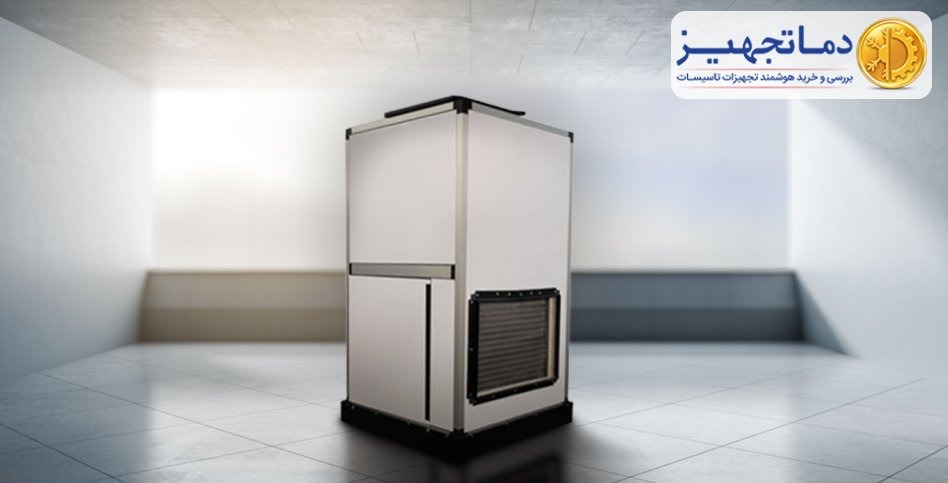
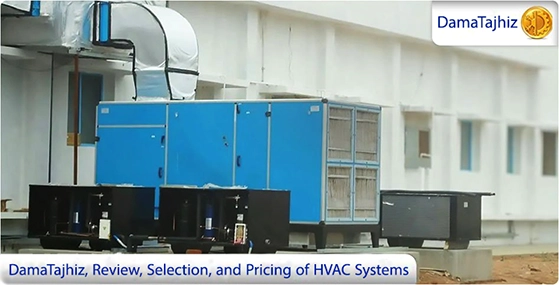
An air washer is an HVAC equipment based on psychrometry and evaporative cooling. Air washers are mainly produced and supplied in residential (apartment) and industrial types with various capacities for air flow, cooling, and heating. The main components of an air washer system include the fan and electric motor, a hot water coil connected to a heating boiler or gas package unit, filters, casing and chassis, evaporative cooling system (water spray nozzles and pump), sensors, controllers, and more. This system is used for heating, cooling, humidifying, dehumidifying, and air washing in buildings, halls, warehouses, exhibitions, and more. Compared to chillers, air washers consume less electricity and have relatively cheaper spare parts.

To thoroughly understand the air washer system, its operation in summer (cooling) and winter (heating) modes will be explained.
Air Washer Operation in Cooling Mode (Summer)
In cooling mode, the air washer works like an evaporative cooling system similar to traditional swamp coolers. The spray nozzles in the device inject water in fine droplets onto the incoming air stream. The evaporation of these droplets lowers the air temperature gradient and increases humidity. Additionally, the air is filtered by the system’s filters.
Since air washers do not require chiller equipment like compressors and condensers during cooling, the initial cost and electricity consumption (due to the absence of a compressor) are lower compared to other HVAC systems, which is a competitive advantage.
The most important parameters for selecting an air washer are summer relative humidity (below 40%) and wet-bulb temperature. Ideally, the output air temperature from the air washer is about 5 to 8 °F (-13.33 °C) higher than the wet-bulb temperature. Therefore, it is best to use air washers in regions where the relative humidity in summer is under 40% and there is a significant difference between dry and wet bulb temperatures (over 18 °F (-7.78 °C)). Based on this, air washers are suitable and compatible with most of Iran’s climates.
As explained in the cooling operation, due to the mixing of air with sprayed water, humidity always increases and cannot be controlled. Therefore, air washers are not suitable for cooling buildings in humid regions (such as coastal cities). For moist areas, alternative systems such as air handling units, chillers, package units, and mini-chillers are recommended.
Review, Selection, and Pricing of HVAC Equipment
Air Washer Operation in Heating Mode (Winter)
In heating mode, air washers perform excellently but require an auxiliary device such as a boiler or heating package to heat the water and send it to the coil inside the air washer. The air washer is equipped with heating coils (hot water or steam) connected via piping to a boiler or gas heating unit. For small (residential) units, the device may connect to a wall-mounted or floor-standing gas package.
Hot water flows through the coil while the fan pushes air over the hot coil, heating the air, which is then distributed inside the building through ducts. The air washer in heating mode has a high coefficient of performance and good heating capacity, functioning similarly to air handling unit heating systems.
One of the main advantages is that installing one air washer in a large space (building, hall, warehouse) can eliminate the need for other heating systems like fan coils, offering high efficiency and lowering total HVAC equipment costs.
Another benefit of the heating mode is humidification. While heating and filtering the air, humidifiers can be integrated if needed to relieve the dryness effects on occupants’ skin and respiratory systems, allowing precise humidity control and achieving optimal indoor air quality.
Air Washer Working Mechanism at a Glance
Air washer systems combine evaporative cooling and hot water or steam heating to provide a comprehensive and economical HVAC solution for various buildings. These systems offer lower electricity consumption compared to chillers and enhance air quality by controlling humidity and filtration, making them ideal, especially for regions with low relative humidity and large dry-wet bulb temperature differences.
However, their limited efficiency in humid climates requires consideration, and alternative HVAC systems may be better suited there. Ultimately, choosing an air washer depends on climate conditions, user needs, and technical parameters to ensure optimal performance and energy savings.
"Knowledge Fuels Better Choices"
Registered Trademark and Stewardship Business Licenses Issued by the Union of Virtual Business Association and the HVAC Equipment Industry.
DamaTajhiz HVAC Participation at International HVAC and Construction Facilities Exhibitions Demonstrates Its Global Reach and Commitment to the Industry.
We Look Forward to Your Call and the Opportunity to Meet With You
SHARE THIS CONTENT TO SPREAD THE KNOWLEDGE
| |