As you know, global warming has become a worldwide issue in recent decades, affecting many people around the world. Iran is no exception, and we are constantly witnessing problems caused by this phenomenon. HVAC equipment can be a practical solution to address such issues, at least in enclosed spaces where we spend most of our time working or resting. One of the HVAC devices used in residential and other types of spaces such as office and commercial buildings to optimize indoor air is the fan coil unit.
This blog post explores the uses, advantages, and working principles of this equipment. To learn more about the different types and the best type of fan coil units, stay with us.

What is a Fan Coil Unit?
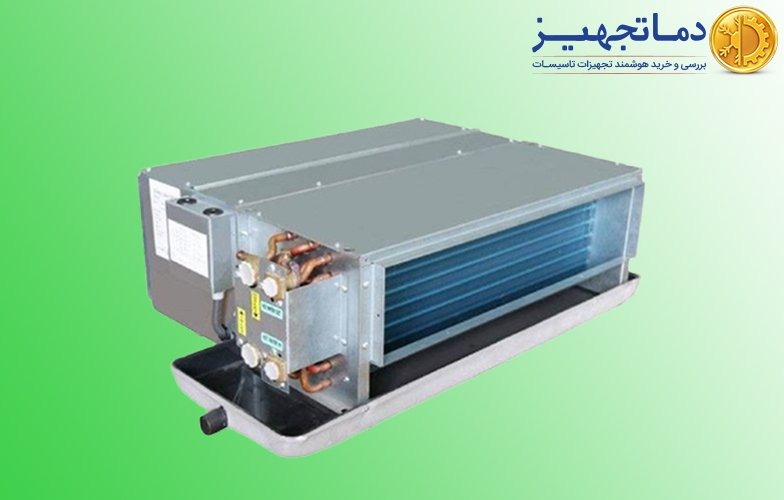
A Fan Coil Unit (FCU) is a device that complements central heating and cooling systems. It consists of various parts such as a blower fan, fan motor, condensate tray, coil (copper pipes with aluminum fins), filter, body, and more. The fan coil uses chilled water from a chiller or hot water from a boiler that flows through its coil. By blowing air over the coil, the unit cools or heats the ambient air. As the name suggests, the fan and coil are the two main components of this system. Fan coil units are manufactured in various types including wall-mounted, floor-standing, cassette, ducted, and ceiling types, with the ceiling type being the most common.
Types of Fan Coil Units
As mentioned, fan coil units come in various models, each suitable for specific installation conditions and environments. Below is a brief overview of the different types and their functionality.
Ceiling Fan Coil Unit (Ceiling FCU)
The ceiling fan coil unit is one of the most widely used models, available in both concealed and exposed types. The concealed ceiling FCU is typically installed above a false ceiling, with only a visible grille through which warm or cool air enters the room. This concealed design and space-saving feature make ceiling units highly popular.
The ceiling FCU draws in air from the bottom, passes it over the coil, and blows it back into the room. The fan speed can be adjusted using a room thermostat, allowing for effective temperature control.
A key consideration when choosing a ceiling FCU is the body dimensions, especially its height, to ensure proper installation above the false ceiling.

Wall Mounted FCU
Wall-mounted fan coil units resemble split AC indoor units. They are mounted on the wall and don't take up floor or ceiling space. Homeowners and developers often favor this model since it's newer than other types, produces less noise, and typically doesn't require a wall thermostat—instead, fan speed and operation are easily adjusted via remote control.

Floor Standing Fan Coil Unit (FCU)
Floor-standing fan coil units are available in top-discharge, front-discharge, and angled models, with airflow capacities up to 1,200 CFM. A thermostat controls their operation. Benefits include easy installation, easy access, and cost-effectiveness compared to other types.
The piping for floor units can be either exposed or concealed. In exposed piping, tubes are mounted on the wall and visible, while in concealed piping, tubes are hidden in the wall or floor, making it more aesthetically pleasing, with only the fan coil unit visible. Affordability and ease of installation continue to make this model popular for offices and homes.

Cassette FCU
Cassette fan coil units are the most modern and advanced type. The coil part is installed above a false ceiling, with only the slim panel visible—similar to ceiling units—and they don’t take up room space, while offering a sleek, modern look. Cassette units are classified by airflow pattern:
-
One‑way cassette FCU (ideal near room edges)
-
Four‑way cassette FCU (ideal for center of the ceiling)
They are also categorized by piping layout:
-
Two‑pipe cassette FCU (one supply and return line feeding one coil)
-
Four‑pipe cassette FCU (two supply and two return lines for separate cooling and heating coils)
The four-pipe cassette must include a motorized valve on the water inlet. Cold or hot water flows through one of the coils depending on thermostat demand, air is drawn through the grille and discharged from the panel’s sides.
Fan speed on cassette units can be adjusted by remote control, or via a three‑speed, two‑season thermostat similar to ceiling units.

Ducted Fan Coil Unit FCU
Ducted fan coil units typically deliver higher airflow and are used in larger spaces such as hospitals, schools, offices, and factories. With airflow capacities ranging from 600 to 2,000 CFM and suitable static pressure, they're ideal for distributing conditioned air via ductwork to adjacent rooms without contamination.

Choosing a Fan Coil Unit: What to Consider?
When buying a product, if we want our desired item to have proper quality and performance, we definitely need to consider some points at the time of selection. Similarly, when deciding on a fan coil, some parameters help us gather enough information for a good choice.
Type of Fan Coil
Experts should select the fan coil type based on the intended use, environment, and budget. Also, when ordering and picking fan coils, be sure to pay attention to whether the water pipe connections are on the left or right side to avoid installation problems.
Fan Coil Unit Capacity
Fan coil capacity is determined based on the cooling load calculation of each space, and preferably, the average speed of the fan coil motor should be the basis for calculating both heating and cooling loads.
Fan Coil Dimensions
Physical dimensions are one of the important parameters in selecting a fan coil. If you plan to order ceiling or cassette fan coils, you should know how much space the selected fan coil will occupy in the room or false ceiling.
The Coil of Fan Coil
The coil pipes carry cold or hot water flow. The common size for copper pipes in this part of the fan coil is 3/8 inch, but using coils with two-row 1/2 inch pipes reduces flow pressure drop and increases the heating efficiency of the fan coil.
Fan Coil Casing
It should be noted that fan coils with a unified body are preferable because multi-piece bodies may cause vibration and noise issues over time between different sections.
Fan Coil Motor
Motors or electric motors used in fan coils are either integrated or repairable. Over time, factors like the type of bearings affect system efficiency and noise levels. Therefore, it is better to use low-noise, multi-speed motors with reliable bearings. Ideally, the operating noise of the fan coil should be less than 35 decibels.
Fan Coil Air Fan
The fan coil air fan is produced in galvanized metal, compressed plastic (ABS), or polyamide (with carbon fiber). Plastic types are cheaper and quieter but less heat resistant and may deform over time during heating use. Metal fans last longer but are noisier and provide moderate airflow. Polyamide fans are the best, being lighter, producing the least noise, providing the highest airflow, and being heat resistant without deforming, though they are more expensive.
Fan Coil Operating Pressure
In towers and buildings with more than fifteen floors, water pressure inside the cooling and heating system pipes and fan coil coils exceeds 6 bar. Therefore, when selecting fan coil coils, the allowable water pressure and working pressure of cold and hot water coils should be precisely considered for high-rise buildings.
Fan Coil Control
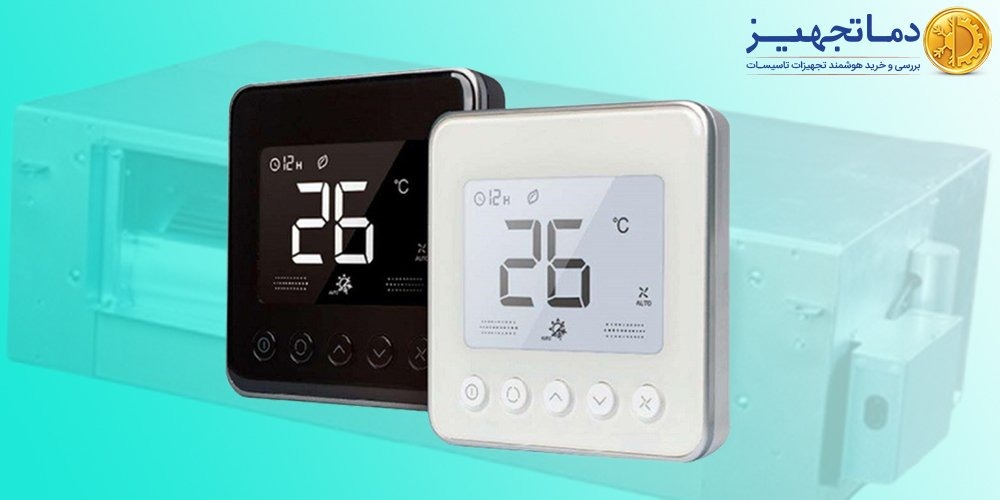
Traditionally, all floor-mounted fan coils have manual switches for on/off and speed control. However, equipping all fan coils with automatic room thermostats is necessary for operation control and energy optimization. Ceiling, wall-mounted, and cassette fan coils also require automatic thermostats and electric three-way valves for start timing, speed adjustment, or motor shutdown, especially due to difficult access.
Damatajhiz; Best Prices and Brands of HVAC Systems and Appliances
Fan Coil Capacity Calculation
The estimated fan coil capacity needed for each of the given area sizes in the table below is approximately based on the indoor design temperature and maximum fan speed. At medium speed, the correction factor for airflow volume compared to high speed is about 0.8, and for cooling and heating power, approximately 0.85. You can also contact Damatajhiz experts for assistance.
Below is the approximate-estimated fan coil capacity for Tehran’s climate conditions.
CFM × 1.7 = m³/hr
| Fan coil capacity | Maximum Infrastructure Used |
| 200CFM | to 12 mm |
| 300CFM | to 20 mm |
| 400CFM | to 28 mm |
| 600CFM | to 40 mm |
| 800CFM | to 56 mm |
| 1000CFM | to 70 mm |
| 1200CFM | to 80 mm |
| 1400CFM | to 95 mm |
| 1600CFM | to 110 mm |
| 1800CFM | to 120 mm |
| 2000CFM | to 140 mm |
Types of FCU in Brief
As mentioned, choosing the right fan coil depends on factors like geographic conditions, area size, required capacity, installation location, and more. Moreover, the fan coil should be purchased from reputable and recognized centers, since warranty and after-sales service are crucial parameters provided only by reliable companies.
In Iran, since 2004, the first and most reputable specialized company in building installation equipment and HVAC systems is DamaTajhiz Specialized Group. You can visit the website to see models, get up-to-date prices, and buy various DamaTajhiz fan coils and other appliances. For more information, call 021-88822550 during office hours to consult with DamaTajhiz Engineering and Manufacturing Company experts.
"Knowledge Fuels Better Choices"
Registered Trademark and Stewardship Business Licenses Issued by the Union of Virtual Business Association and the HVAC Equipment Industry.
DamaTajhiz HVAC Participation at International HVAC and Construction Facilities Exhibitions Demonstrates its Global Reach and Commitment to the Industry.
We Look Forward to Your Call and the Opportunity to Meet With You
SHARE THIS CONTENT TO SPREAD THE KNOWLEDGE
| |