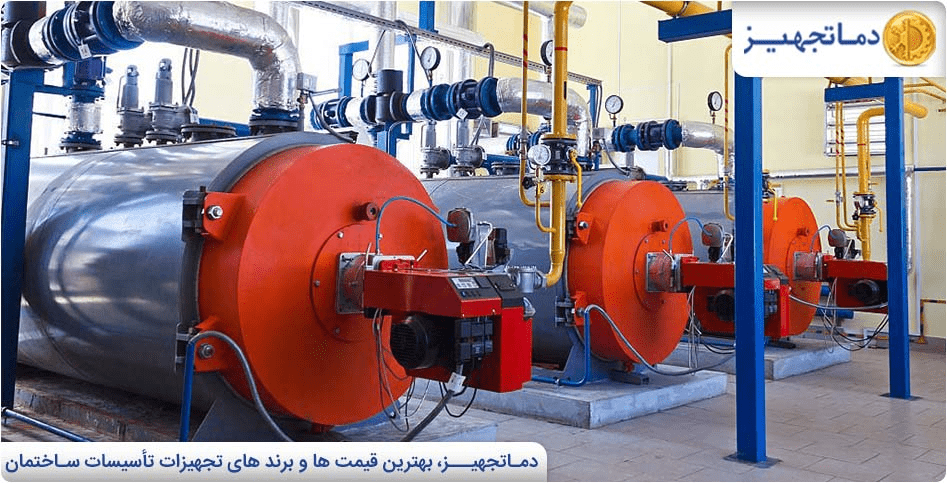
One of the most crucial decisions when establishing a central boiler room is selecting between a steel boiler and a cast-iron boiler. In general, the boiler’s function in central heating plants is to supply the hot water required for the building’s heating systems.
Central heating boilers are manufactured in both steel and cast iron types, in various capacities and brands, each with its own characteristics. This article focuses on the differences between steel and cast iron boilers. Please continue reading to gain a clearer understanding of their distinctions through a technical comparison. The main performance differences between steel and cast iron boilers, which will help you make a better decision when selecting your central heating boiler, are as follows:
Review, Selection, and Pricing of HVAC Equipment
Differences Between Steel and Cast Iron Boilers in Terms of Material
Steel Boiler: In manufacturing a steel hot water boiler, the combustion chamber and tube networks are made from special alloy steel designed for pressure vessels and are fabricated as a single integrated unit.
Cast Iron Boiler: In producing a cast iron boiler, as its name implies, molten cast iron is poured into molds using a casting process. Naturally, its strength and heat transfer coefficient are lower than those of steel.


Steel vs. Cast Iron Boilers in Terms of Installation and Transport
Cast Iron Boiler: The installation and assembly of a cast iron boiler are carried out in the boiler room by joining and assembling the cast iron sections known as “fins” or “segments.” This modular design makes transportation and handling much easier.
Steel Boiler: Unlike the cast iron type, the steel boiler is manufactured as a single solid piece and, due to its heavier weight, is more difficult to transport.
Steel vs. Cast Iron Boilers: Performance
Steel Boiler: Steel hot water boilers have larger heat absorption surfaces and higher thermal conductivity and efficiency compared to cast iron types. They are suitable for providing heating in industrial facilities and high-rise buildings. Moreover, they can be manufactured in higher capacities and operating pressures for large-scale projects.
Cast Iron Boiler: The maximum water pressure that a cast iron boiler can withstand is about 7 bar, equivalent to the water column height of a 20-story building. However, due to its modular and sectional design, it is much easier to transport and install compared to steel boilers.
DamaTajhiz: Guide to Selection and Pricing of HVAC and Building Facilities Equipment (Since 2004)
Comparison Between Cast Iron and Steel Boilers' Price
Cast Iron Boiler: Cast iron hot water boilers are less pricey in comparison with steel ones due to their lower capacity, lower working pressure, and reduced maintenance costs. Additionally, repairing them is easier, as any damaged or perforated section can be replaced.
Steel Boiler: The price of steel boilers, especially standard models with higher operating pressure, is generally higher than that of cast iron boilers, and correspondingly, their repair costs are also greater.
Cast Iron vs. Steel Boilers: Capacity Modification
Steel Boiler: Steel hot water boilers are mainly cylindrical, horizontal, and monolithic, meaning their size and capacity are fixed and cannot be changed.
Cast Iron Boiler: Because of its sectional (modular) structure, the capacity of a cast iron boiler can be increased or decreased by adding or removing sections.
Difference in Burners Used for Cast Iron and Steel Boilers
Cast Iron Boiler: Cast iron boilers are typically used in small to medium-sized heating systems, and therefore, they use smaller burners with lower thermal capacity. In these boilers, gas or oil burners with short flames and low pressure are more suitable, since the combustion chamber design of a cast-iron boiler cannot withstand extremely high temperatures or high pressures. In most cases, the burner of a cast iron boiler is monobloc (integrated), which makes installation and maintenance easier.
Steel Boiler: In contrast, steel boilers are commonly used in larger heating systems such as industrial and commercial boiler rooms, and they require boiler burners with higher capacity and longer flames. The combustion chamber in steel boilers is larger and more durable, allowing the use of high-pressure burners. These systems often use two-stage or modulating burners to provide better control over fuel consumption and outlet temperature. The burner type may be gas, oil, or dual-fuel, and it is typically mounted separately from the boiler body for easier servicing and replacement.
Steel vs. Cast Iron Boiler in Brief
In summary, choosing the right boiler type is crucial for achieving an efficient central heating system. A steel boiler offers high durability, superior thermal efficiency, and the ability to operate under high pressure and large capacities, making it ideal for industrial facilities and high-rise buildings. On the other hand, a cast iron boiler is easier to transport and install due to its sectional design and is more affordable in both initial cost and maintenance. Overall, steel boilers are recommended for large-scale, high-pressure applications, while cast iron boilers are a practical and economical choice for small to medium-sized buildings.
Furthermore, if you need more pointers on which cast iron or steel hot water boilers you should select, compatible with your engine room, please don't hesitate to ask DamaTajhiz. You can order any HVAC and MEP products, including different types of air washers, cooling towers, air handling units, chillers, industrial evaporative coolers, air curtains, boiler burners, heat exchangers, gas heaters, unit heaters, circulation pumps, sand filters, water and fuel storage tanks, and more, from countries such as the UAE, Armenia, Tajikistan, Georgia, Azerbaijan, Turkey, Oman, Pakistan, Turkmenistan, Georgia, Kuwait, Uzbekistan, Qatar, Iraq, and others across Asia, the Middle East, and Europe, and have them delivered to your city (Manama, Baghdad, Karachi, Dubai, Sharjah, Muscat, Riyadh, Abu Dhabi, Kuwait City, and Doha Amman, Sulaimaniyah, Kirkuk, Islamabad, Mosul, Erbil, Dushanbe, Aleppo, Damascus, Baku, etc.) in the shortest possible time. Furthermore, you can ask any question in the HVAC area of expertise and receive a free consultation from our professional team members by calling +98-930-288-0251 or sending a WhatsApp message to this number.
"Knowledge Fuels Better Choices"
Registered Trademark and Stewardship Business Licenses Issued by the Union of Virtual Business Association and the HVAC Equipment Industry.
DamaTajhiz HVAC Participation at International HVAC and Construction Facilities Exhibitions Demonstrates its Global Reach and Commitment to the Industry.
We Look Forward to Your Call and the Opportunity to Meet You
SHARE THIS CONTENT TO SPREAD THE KNOWLEDGE
| |